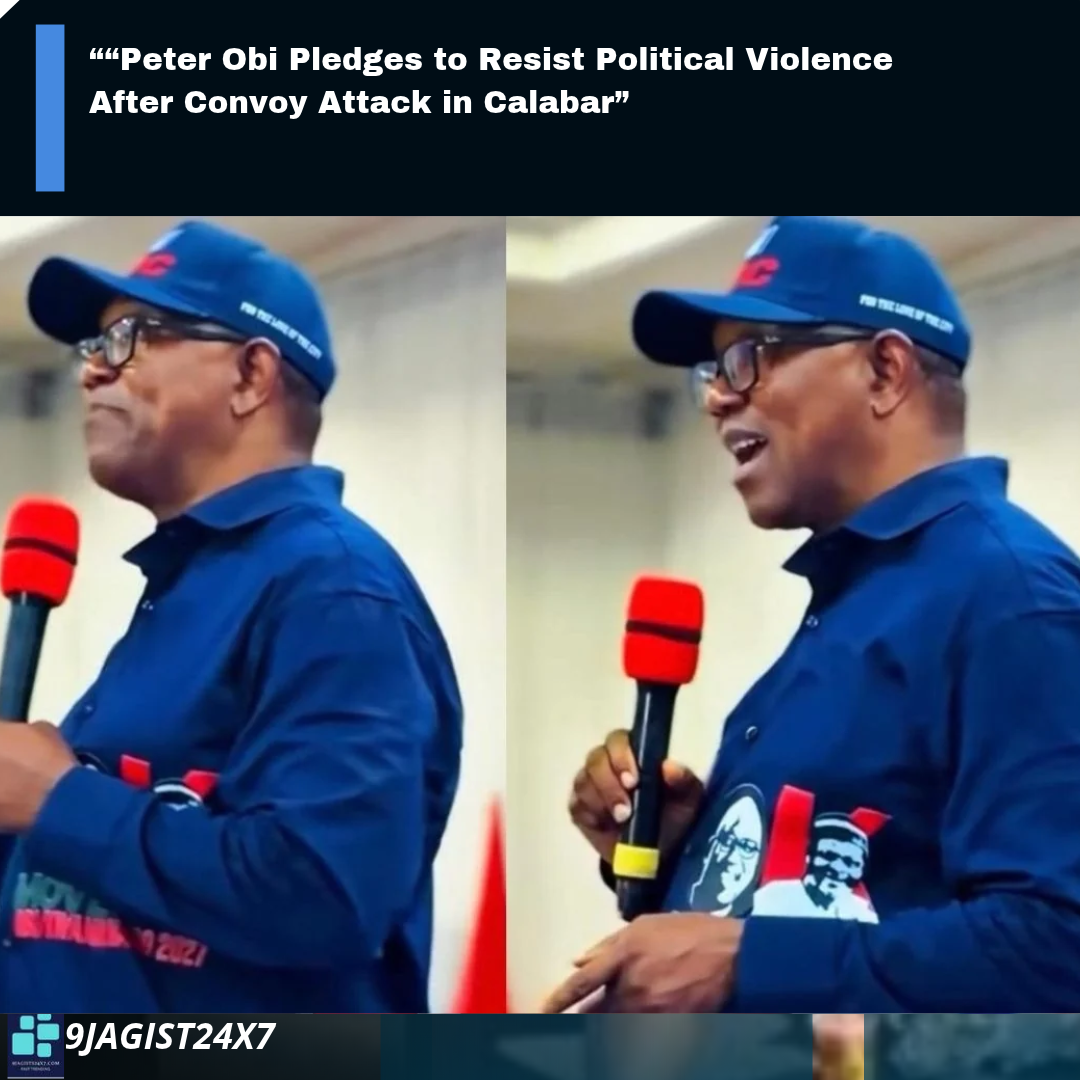
Former Labour Party presidential candidate Peter Obi has vowed to resist political violence after an alleged attack on his convoy by suspected political thugs in Calabar, Cross River State. The incident reportedly occurred shortly after Obi arrived in the city with his wife, Margaret, and running mate, Rabiu Kwankwaso, for a town hall meeting.
Advertisements
Obi said his security team informed him that some people were throwing stones at the convoy, causing others nearby to flee. According to him, the security personnel suggested taking another route after noticing that the attackers had machetes and other weapons.
Advertisements
“They said APC people were throwing stones and people were running back, and my security people said, ‘We’ve found another way.’ They had machetes and the rest. I said, ‘In Nigeria? I’m coming down to video everything.’ By the time they saw what was happening, they left,” Obi said.
Obi’s Message to Nigerians
The former Anambra State governor used the incident to criticise what he described as a culture of tolerance for political intimidation in Nigeria. He argued that political violence continues because citizens and institutions allow it to happen without consequence.
“All these things happen because Nigerians allow it, but we are not going to allow it in 2027,” Obi said.
His statement goes beyond condemning the alleged attack. It is also a warning ahead of the 2027 general elections that political actors and their supporters should not use intimidation, weapons, or violence to suppress opponents or discourage voters.
Obi’s decision to step out and record the situation was presented as an act of defiance. Rather than quietly avoiding the confrontation, he said he wanted to document what was happening so that the incident could not be denied or ignored.
The report says Obi’s media aide, Ester Umoh, had earlier raised an alarm over an alleged attempt by suspected thugs to attack the convoy. The incident was said to have happened shortly after the presidential candidate arrived in Calabar for the town hall meeting.
Obi’s account suggests that the attackers were politically motivated and associated with the All Progressives Congress. However, the report does not state that the attackers have been identified, arrested, or formally linked to any political party.
That distinction is important. An allegation of political violence can be serious, but it must be investigated and verified before responsibility can be assigned. Security agencies would need to examine witness accounts, video evidence, the route taken by the convoy, and any available surveillance footage.
Political violence is not only a threat to candidates and their aides. It can also intimidate ordinary citizens, discourage voter participation, and make elections less free and fair.
When supporters or suspected thugs attack a political convoy, the message is often larger than the immediate confrontation. It can signal that certain candidates or communities are not welcome, that political space is controlled through fear, or that opponents may face danger if they campaign openly.
Obi’s warning that such behaviour will not be tolerated in 2027 reflects a broader concern about whether Nigeria can conduct peaceful elections in a highly charged political environment.
The alleged attack places responsibility on security agencies to act quickly and impartially. If there is credible evidence that a political convoy was attacked, investigators should identify those involved, establish whether the incident was politically motivated, and hold responsible persons accountable.
Failure to act could reinforce the belief that political violence carries no consequences. That, in turn, may encourage more intimidation as the 2027 campaign intensifies.
Obi’s comments put pressure on authorities to show that no candidate, regardless of party affiliation, should be subjected to violence while engaging citizens.
The Calabar incident is a reminder that election campaigns in Nigeria can quickly become dangerous when political rivalry turns into physical confrontation. Obi’s response signals that he intends to confront such incidents publicly rather than ignore them.
Whether his vow changes anything will depend on what happens next: whether the alleged attackers are investigated, whether political leaders condemn violence clearly, and whether security agencies protect candidates and voters throughout the campaign.
For now, Obi has turned an alleged attack into a political message: Nigeria cannot claim to be preparing for a democratic election if candidates and citizens remain vulnerable to intimidation and violence.
Advertisements