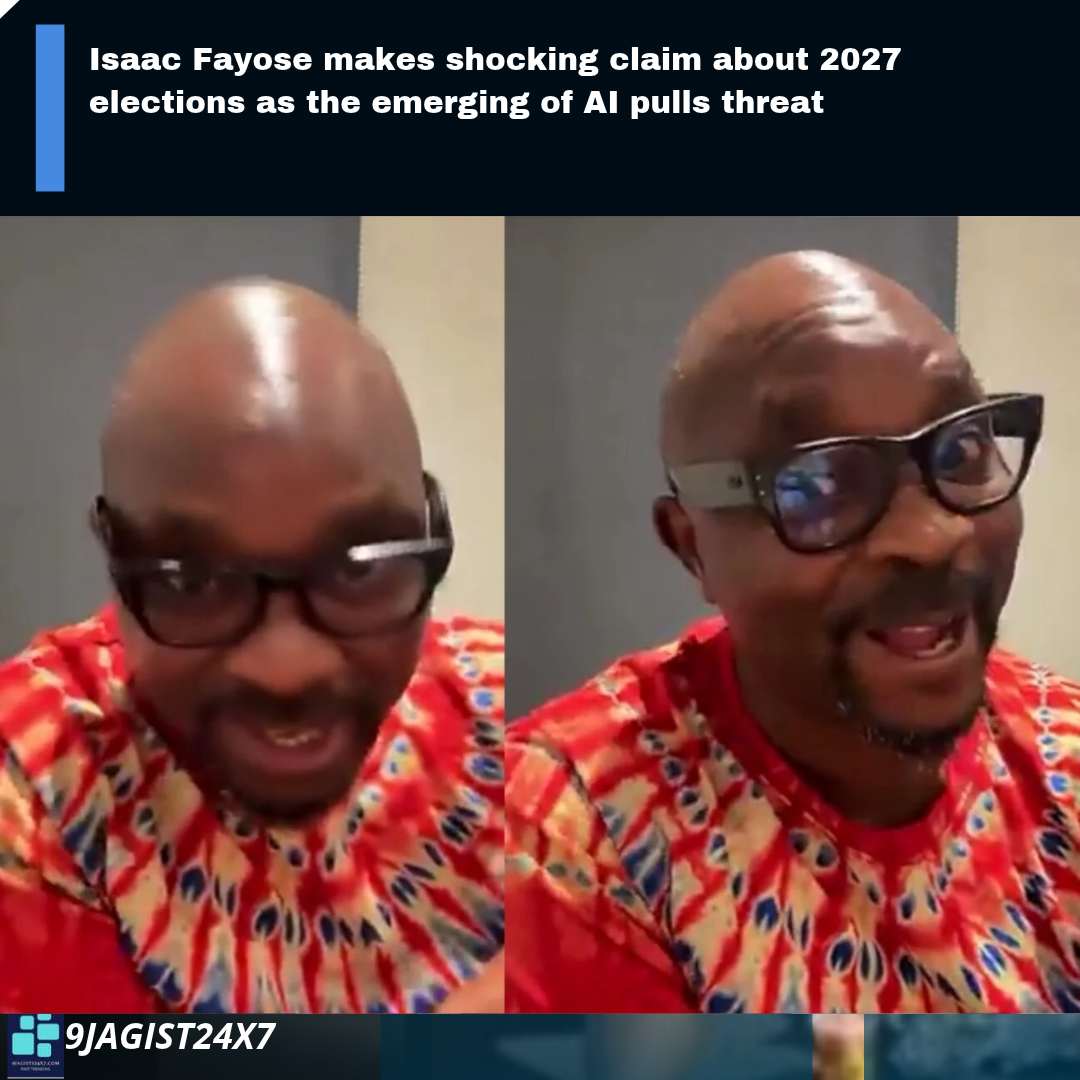
Businessman and social commentator Isaac Fayose has alleged that more than 50 million artificial intelligence-generated voters could compete with human voters in Nigeria’s 2027 general elections. In a viral video, he warned that such technology could be used to inflate results and undermine the votes legitimately cast by registered Nigerians.
Advertisements
Fayose also called for the resignation of the Chairman of the Independent National Electoral Commission, Professor Joash Amupitan, arguing that INEC can no longer be trusted to conduct a credible election in 2027. He urged President Bola Tinubu and Nigerians to demand new, neutral leadership at the electoral commission.
Advertisements
The Claim Behind the Alarm
Fayose claimed that fictitious voter identities could be introduced into the electoral process, allowing political actors to inflate figures beyond the votes actually cast by human beings. He said Nigerians would be forced to compete with “AI voters,” warning that the scale of such manipulation could overwhelm genuine participation.
“As it is, they have over 50 million AI, AI-generated voters. They’re going to compete with you in 2027,” Fayose said. “For 50 million AI, you go vote, vote tire.”
His claim suggests that artificial intelligence could be used to create fake voter identities or fabricated electoral records. However, he did not present documentary evidence, technical findings, or named sources to substantiate the allegation. The claim has not been independently verified.
Why He Wants INEC’s Chairman Out
Fayose went beyond raising concerns about AI. He directly accused the INEC chairman of being a tool for the All Progressives Congress and alleged that the commission could be used to manipulate the 2027 polls.
“The INEC chairman must go. He is APC’s tool to rig the 2027 polls,” Fayose declared.
His demand for Amupitan’s resignation is part of a broader argument that electoral credibility depends not only on technology but also on the independence and neutrality of those managing the process. Fayose argued that if the current INEC leadership remains in office until 2027, the votes of Nigerians may not count.
Allegations About Ekiti Elections
Fayose also used the video to question past election figures in Ekiti State. He claimed that voter turnout in the state had historically remained below 400,000, while election results were allegedly inflated to about one million.
“Ekiti people, when they vote for Ekiti, they no reach 400,000. They don puff them up to one million. Those are the AIs,” he alleged.
He further suggested that additional Permanent Voter Cards could be circulated, allowing one person to assume different identities during voting. In his view, that could make it difficult to establish whether every recorded vote came from a genuine, eligible voter.
These allegations are serious, but they remain unproven. The reports make clear that Fayose did not provide evidence to support his claim that AI-generated voters exist or that such a system was used in previous elections.
The Real AI Threat to Elections
Even if AI-generated voters do not exist in the way Fayose describes, artificial intelligence does pose real risks to elections. AI can be used to create convincing fake images, videos, audio recordings, and social-media campaigns designed to mislead voters.
The concern is not necessarily that a computer can physically vote, but that AI can amplify disinformation, impersonate public figures, manipulate public opinion, and create confusion around candidates, results, or voting procedures. In a highly polarised political environment, such content can spread quickly before fact-checkers or electoral authorities can respond.
Fayose’s comments add to a growing debate in Nigeria about how electoral institutions should prepare for AI-driven misinformation, deepfakes, and digital manipulation ahead of 2027.
If Nigeria wants to protect the credibility of the 2027 election, INEC would need to strengthen verification systems across the voter register, biometric identification, result transmission, and public communication.
That includes ensuring that voter records contain accurate biometric data, preventing duplicate registrations, auditing the voter register, securing electronic systems, and making election results traceable from polling units to collation centres. It also requires clear public education so voters can identify official information and reject false claims.
AI-related risks cannot be addressed by rhetoric alone. They require technical safeguards, independent audits, transparent processes, and credible institutions that voters trust.
Fayose’s allegation has generated attention because it speaks to a deep public anxiety about election integrity. Many Nigerians remain sceptical about whether their votes will count, especially after past disputes over results, technology, and transparency.
But an allegation of more than 50 million AI-generated voters is extraordinary. Such a claim would require extraordinary evidence: details about how the identities were created, where they entered the system, who controlled them, and how they could be deployed during voting or collation.
Without that evidence, the claim remains a warning rather than a verified fact. Still, it puts pressure on INEC to demonstrate that Nigeria’s electoral systems are secure enough to withstand both real manipulation attempts and unfounded claims that could itself undermine confidence in the process.
The 2027 election is still ahead, but the debate over AI, voter verification, and INEC’s independence has already begun. Fayose’s demand for a new INEC chairman is likely to resonate with critics who distrust the commission, while supporters of the current leadership will insist that allegations must be backed by evidence.
The larger issue is whether Nigeria can build an electoral process strong enough to withstand both technological threats and political suspicion. If voters are to trust the outcome in 2027, INEC will need to show—not merely assert—that every vote recorded in the system belongs to a real, verified human voter.
Advertisements