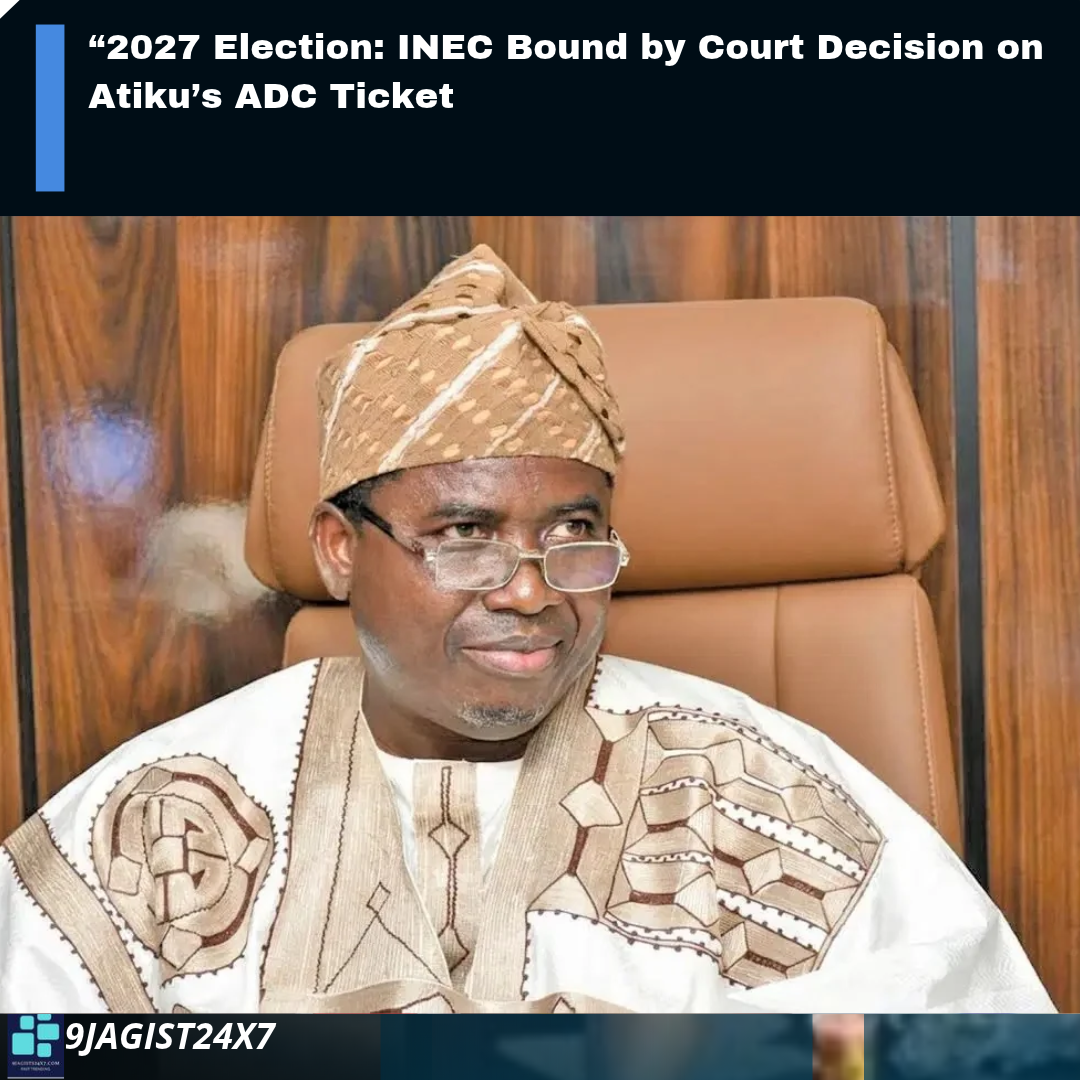
The Chairman of the Independent National Electoral Commission (INEC), Professor Joash Amupitan, says the commission will comply with any final court ruling on whether former Vice-President Atiku Abubakar can contest the 2027 presidential election on the African Democratic Congress (ADC) platform.
Advertisements
Amupitan spoke on Thursday at Chatham House in London during a dialogue on Nigeria’s 2027 elections, organised with the Kimpact Development Initiative. He said INEC was constitutionally obliged to obey court orders, especially those from the Supreme Court, irrespective of public reaction.
Advertisements
“If he eventually fails, well, I’m obligated under Section 285 of the Constitution of Nigeria to obey every court order, especially if it is from the Supreme Court,” Amupitan said.
His comments came after a Federal High Court in Abuja nullified the David Mark-led ADC leadership and invalidated decisions taken under it, including the process that produced Atiku as the party’s presidential candidate for the 2027 election.
The court decision
On November 5, 2026, Justice Peter Lifu of the Federal High Court, Abuja, declared the Mark-led ADC caretaker committee illegal and nullified its decisions.
The court also invalidated decisions arising from the party’s 99th National Executive Committee meeting of July 27, 2025, and restrained INEC from recognising or acting on those decisions.
That ruling directly affected Atiku’s candidacy because the court held that the nomination process under the Mark-led leadership was invalid. The suit was filed by former ADC Deputy National Chairman, Nafiu Bala Gombe, who challenged the emergence of the Mark-led executive after the resignation of former National Chairman Ralph Nwosu and other officials.
Atiku’s appeal
The ADC has rejected the judgment and filed an appeal, as well as an application for a stay of execution. At the time of reporting, the stay application had not been heard or granted.
That means Atiku remains legally engaged in a live dispute over his candidacy; he has not been finally barred from the ballot. But if the appeal fails and the judgment stands, Amupitan’s position indicates that INEC would be required to give effect to the court’s decision
The distinction matters: the court has nullified the process that produced Atiku’s candidacy, but the final electoral consequence depends on the outcome of the appeal and any further court orders.
Why timing is critical
Amupitan said INEC had sought an accelerated hearing when the ADC dispute emerged in April because it wanted the matter resolved within three weeks. He said the commission had complied with a directive to suspend action pending the outcome of the case, which later went on appeal.
The chairman also disclosed that INEC had more than 300 pending cases against it as the 2027 elections approached. He said the commission had begun procuring sensitive election materials and urged reforms that would ensure pre-election disputes are resolved six months to one year before voting.
INEC’s official timetable lists the presidential and National Assembly elections for January 16, 2027. That leaves very little administrative space if the ADC appeal is not resolved quickly.
What it means for Nigerian voters
For voters, the case is a reminder that party nominations can become as consequential as the general election itself. A candidate may be popular, well funded and politically prominent, but still face exclusion if the legal process that produced the nomination is successfully challenged
For the ADC, the immediate task is to secure a favourable appellate ruling or a stay of execution before the election timetable becomes too tight. For INEC, the task is to follow valid court orders without appearing to take sides in an intra-party political fight.
Advertisements