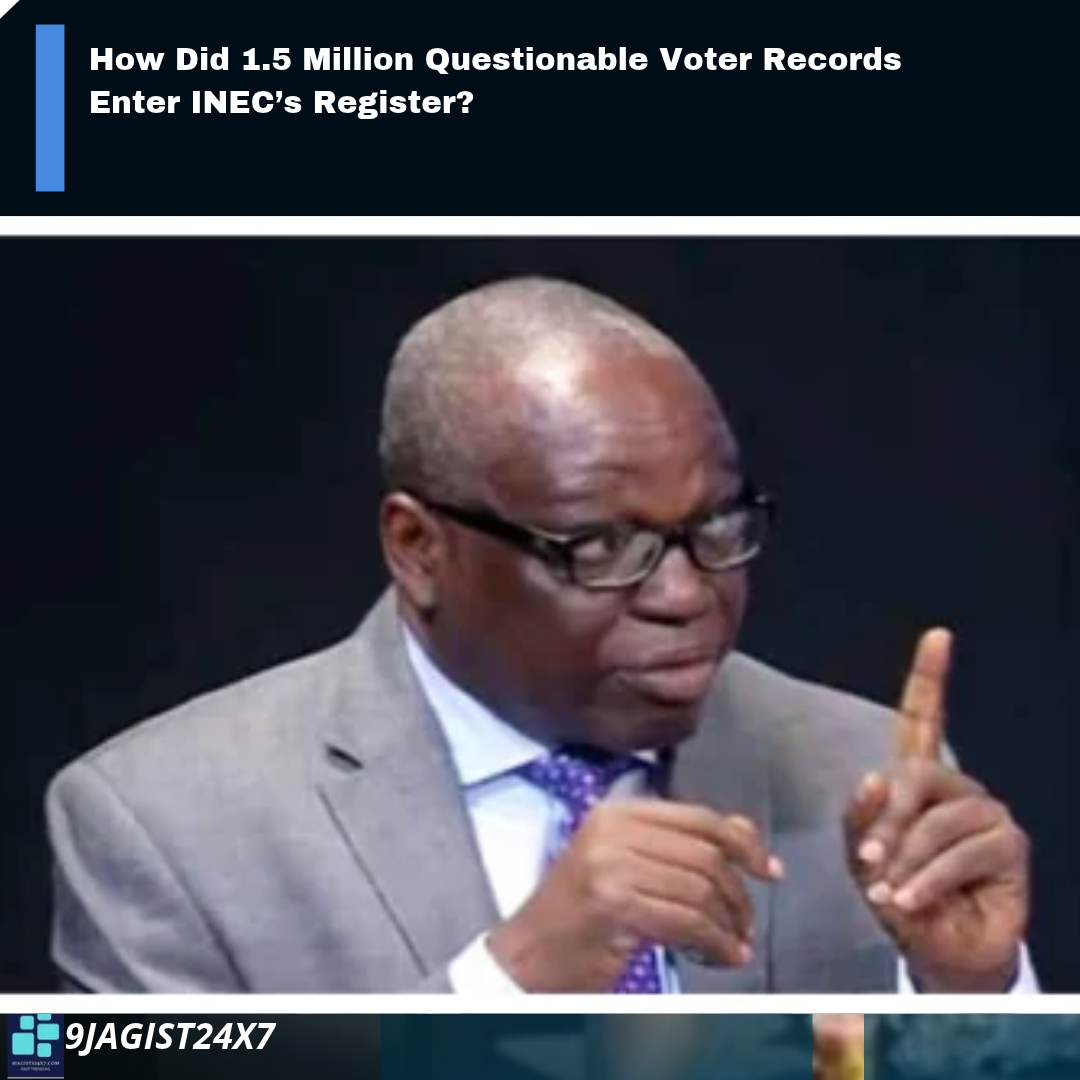
Former Director of Voter and Publicity Education at the Independent National Electoral Commission, Oluwole Osaze-Uzzi, has demanded an explanation from INEC Chairman Joash Amupitan over how 1.5 million questionable voter records entered the commission’s register. Speaking on Arise Television, Osaze-Uzzi said such anomalies should not have occurred given the technological safeguards INEC has in place to prevent multiple registrations and irregular entries.
Advertisements
His comments have intensified scrutiny of Nigeria’s voter register ahead of the 2027 general elections. The former INEC official argued that the law is clear about who qualifies to register, while the commission’s biometric systems should make it difficult for duplicate, invalid, or suspicious records to enter the database
Advertisements
Osaze-Uzzi said the eligibility rules are straightforward: a Nigerian citizen aged 18 or above should be able to register and appear on the voter roll. He added that registration requires physical presence and biometric capture, making the process simpler in principle than it appears in practice.
“The work ordinarily ought to be easier for the commission. The law is quite clear about who is entitled to be on the register: you’re a Nigerian citizen, you’re 18 years and above, and then you go there, and you register,” he said.
He questioned how up to 1.5 million questionable entries could have been made despite the systems designed to block multiple registrations. He referenced artificial intelligence and multiple registrants, saying such problems should not occur when the commission has put safeguards in place.
INEC’s voter registration system is supposed to rely on biometric data, including fingerprints, to prevent one person from registering multiple times. Tools such as the Automated Fingerprint Identification System and artificial intelligence can help detect duplicate records, unusual patterns, and inconsistencies in the register.
Osaze-Uzzi acknowledged that these tools can assist in filtering duplicates. However, he argued that identifying flawed records after the fact is not enough. INEC must explain how the questionable entries entered the database in the first place.
That distinction is crucial. A register may contain errors because of human mistakes, data migration problems, poor record matching, or deliberate manipulation. Without a transparent explanation, it becomes difficult to know whether the 1.5 million records represent isolated technical failures or a deeper weakness in the registration process.
What INEC Has Not Clarified
According to Osaze-Uzzi, INEC has yet to clarify the exact timeframe covered by the database review or explain how the flawed entries were originally detected.
That lack of detail matters because the credibility of a voter register depends on transparency. Voters, political parties, civil society groups, and election observers need to know which registration periods are affected, how the questionable records were identified, and what steps INEC is taking to remove or correct them.
If the commission cannot provide clear answers, public confidence in the electoral process may suffer—especially with the 2027 elections approaching.
The voter register is the foundation of any credible election. If it contains duplicate, invalid, or fabricated records, it can create opportunities for manipulation, disputes over results, and accusations of rigging.
A flawed register can also affect planning. INEC uses voter data to determine polling unit distribution, ballot production, logistics, and result collation. Questionable records can therefore create operational problems beyond the question of who is eligible to vote.
For citizens, the issue is personal. A voter whose record is wrongly flagged, duplicated, or removed could be disenfranchised. Conversely, invalid entries could undermine confidence that every vote cast belongs to a real, eligible Nigerian.
Osaze-Uzzi’s demand puts pressure on INEC Chairman Joash Amupitan to provide a full public explanation. As the head of the commission, he will be expected to reassure Nigerians that the register is being cleaned, audited, and protected from manipulation.
The controversy comes at a sensitive time. INEC has already warned about AI-generated fake results, manipulated announcements, and digital disinformation ahead of the 2027 elections. Now, questions about the integrity of the voter register add another layer to concerns about election security.
To restore confidence, INEC would need to publish clear details about the review: how many records were flagged, which states or registration periods they came from, what categories of errors were found, and how the commission plans to correct them.
It would also need to explain whether the records involve duplicate registrations, ineligible persons, biometric mismatches, suspected fraud, or technical errors. Finally, INEC should show how it is preventing similar problems from occurring in future registration exercises.
Until then, Osaze-Uzzi’s warning remains a serious challenge to INEC: a voter register with 1.5 million questionable entries cannot simply be cleaned quietly; Nigerians deserve to know how the problem happened and who is responsible.
Advertisements