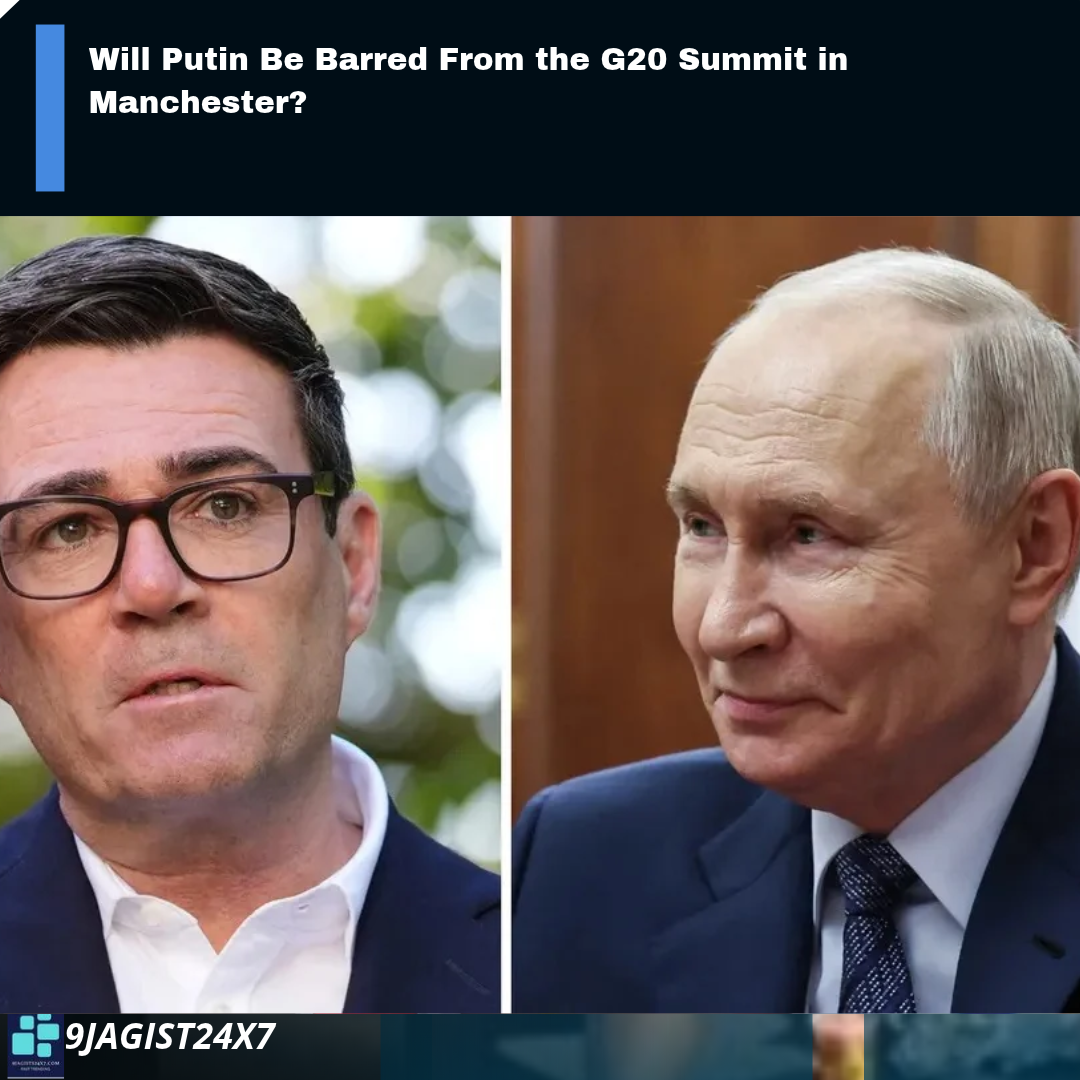
British Prime Minister Andy Burnham has said Russian President Vladimir Putin will not attend the G20 summit in Manchester in November 2027 because of sanctions against senior Russian figures. His position puts the UK at odds with US President Donald Trump, who has invited Putin to this year’s G20 summit in Miami in December.
Advertisements
Burnham was asked by The Economist whether Putin would be invited to the Manchester summit. His answer was direct: “No.” He said the guest list was handled by the G20, but maintained that Putin “will not be coming because of an outstanding sanction.”
Advertisements
A Clear Break With Trump
Burnham’s remarks contrast sharply with Trump’s decision to invite Putin to the Miami summit. While the Kremlin has not confirmed whether the Russian president will attend, the difference in approach highlights a growing divide between Washington and London over how to engage Moscow.
Britain has maintained a policy against direct bilateral engagement with Russian ministers since Moscow launched its full-scale invasion of Ukraine in 2022. Burnham’s refusal to invite Putin is consistent with that position and signals that the UK does not intend to normalise relations with senior Russian officials while the war continues.
Foreign Secretary Ed Miliband has previously said the UK would retain that stance, while acknowledging that the United States could make its own decisions about invitations.
Tensions Already Visible
The disagreement over Putin’s attendance did not begin with Burnham’s comments. Tensions were evident at the G20 foreign ministers’ meeting in October, when a planned group photograph was cancelled after European representatives, including Miliband, refused to pose alongside Russian Foreign Minister Sergei Lavrov.
Miliband addressed Lavrov directly during the meeting, saying: “Let me say this directly to the Russian foreign minister: We all know who the aggressor in this war is.”
That moment showed how the war in Ukraine continues to shape diplomacy at global gatherings. Even when countries share a forum such as the G20, disagreements over accountability, sanctions, and engagement with Moscow can disrupt basic diplomatic rituals.
Russia remains a member of the G20, which comprises 19 countries, the European Union, and the African Union. Ukraine is not a member, although the war has featured prominently at recent summits.
That creates a diplomatic dilemma. The G20 is designed to bring major economies together, but Russia’s continued membership means its representatives may still appear at meetings even when individual hosts or members object to their presence.
Burnham’s position suggests that the UK intends to use its hosting role to draw a clear line: Russia may remain part of the G20, but its president will not be welcomed in Manchester while sanctions remain in place.
The UK has remained a strong supporter of Ukraine under successive prime ministers since the invasion began. Burnham’s refusal to invite Putin fits within that broader policy of isolating Russian leadership and maintaining pressure on Moscow.
For Ukraine and its European allies, the message is important. It signals that Britain does not see the war as a distant geopolitical issue, but as a conflict that should influence how Russia is treated in international institutions.
For Trump, however, the decision to invite Putin suggests a different approach: engagement with Moscow, even amid ongoing disagreement over Ukraine. The contrast could complicate coordination between Western allies ahead of the 2027 summit.
Burnham also said he wanted to welcome Chinese President Xi Jinping to Manchester, a city Xi visited in 2015. He described a “real opportunity” to strengthen economic cooperation following former Prime Minister Keir Starmer’s visit to Beijing earlier this year.
The prime minister identified artificial intelligence safety as another potential area for cooperation with China. He said the summit could provide an opportunity to pursue international agreements with Beijing.
Asked whether Britain could bring the United States and China together on global AI oversight, Burnham acknowledged the difficulty. “As I sit here today, that feels challenging, but we’ve got to hold out the need to find global agreements on AI,” he said. “If we don’t, the risks of recent times will magnify, they will significantly intensify. So you’ve got to go into it with that aim.”
The two-day G20 summit will take place at the Manchester Central Convention Centre, bringing together world leaders, diplomats, and thousands of delegates. It will be the first time Britain has hosted the gathering since 2009.
The government says its 2027 G20 presidency will focus on strengthening global economic stability and delivering benefits across the UK.
But before the summit begins, Burnham will have to manage a difficult diplomatic balance: excluding Putin while preserving the G20’s role as a forum for major powers, welcoming China while addressing concerns about AI and security, and working with the United States despite their disagreement over Russia.
Advertisements