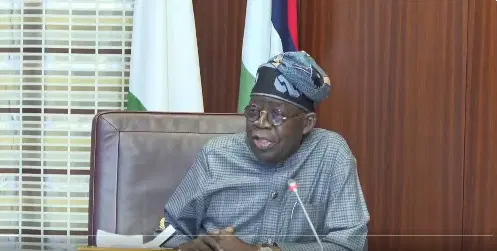
President Bola Tinubu has directed all 36 states to accelerate implementation of the National Affordable CNG Transit Programme, declaring that commuters nationwide must begin seeing measurable reductions in transport fares from October 1. In a personally signed statement released Saturday, September 19, the President said the deadline follows an August 27 meeting with state governors, where the group agreed that more Nigerians should start feeling lower transport costs by that date. An implementation committee under the Nigeria Governors’ Forum, chaired by Kwara State Governor AbdulRahman AbdulRazaq, has been set up to drive the effort.
Advertisements
The evidence-based case
Advertisements
Tinubu built his argument around a list of state-level examples he says are already delivering savings: CNG and electric transport in Borno charging ₦50–₦100 against commercial rates of ₦300–₦600; 100 CNG buses in Kaduna offering free rides that reportedly carried 3.2 million passengers and saved commuters over ₦3.5 billion in their first year; the Lagos–Ibadan fare in Oyo cut from roughly ₦8,000 to ₦3,200; and comparable reductions cited in Adamawa, Enugu, Plateau, Abuja, Niger, and Abia. He also cited broader infrastructure gains — more than 120,000 converted vehicles, over 400 conversion centres, and over 90 refuelling stations nationwide. Presented this way, the administration frames the October 1 target not as a promise but as an extension of results it says are already measurable.
The policy-alternative angle
Tinubu explicitly rejected calls — which he did not attribute to anyone by name — to reinstate the fuel subsidy in response to renewed pressure on petrol and diesel prices from global energy disruptions, calling that approach “ruinous” and fiscally costly. Read in that light, the CNG push functions as the government’s substitute for subsidy politics: an attempt to shield Nigerians from fuel costs through a structural shift to domestic gas rather than a return to price controls.
The political-contest angle
The statement lands amid public sparring between Tinubu and opposition figures over energy policy. Related reporting from the same outlet shows former Vice President Atiku Abubakar urging Tinubu to adopt a “production-subsidy model” and separately claiming credit for the CNG initiative’s underlying idea — context that positions Tinubu’s announcement as part of a live political argument over who owns the policy and whether it goes far enough, not simply a technical transport update.
The accountability-and-verification angle
Tinubu’s litany of savings figures — passenger counts, naira amounts, percentage cuts — comes entirely from the presidency’s own account and has not been independently corroborated in this report. Given that the target date, October 1, is now less than two weeks away, the more immediate test will be whether commuters in cities without existing CNG deployments experience any fare movement at all, since much of the evidence cited applies to states where programmes were already running before this directive was issued.
Advertisements