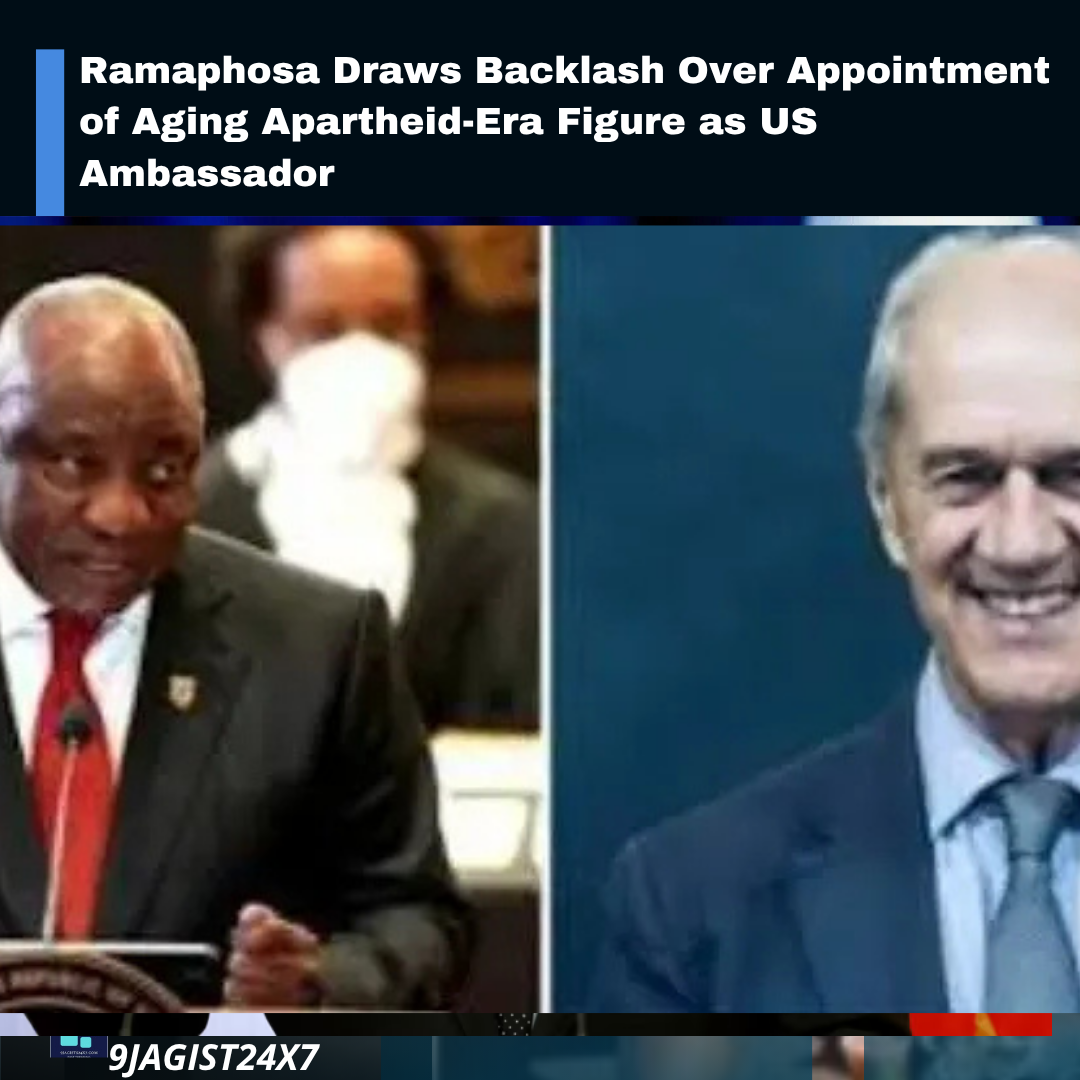
South African President Cyril Ramaphosa has named Roelf Meyer, a veteran of the country’s final apartheid-era administration, as the nation’s new envoy to Washington.
Advertisements
Meyer previously served as the chief negotiator for the National Party — the political force behind apartheid — during the landmark transition talks of the early 1990s, while Ramaphosa sat across the table representing Nelson Mandela’s ANC. The two men famously bonded over a shared fishing trip during that period and have maintained a close friendship ever since.
Advertisements
More recently, Meyer was among 32 distinguished South Africans selected by Ramaphosa to participate in a national dialogue initiative designed to tackle the country’s pressing social and political issues. He had previously held the position of constitutional affairs minister under the last apartheid government before joining Mandela’s government of national unity in 1994. He departed two years later, going on to co-found the United Democratic Movement, and eventually became an ANC member.
The appointment has drawn criticism from some quarters. AfriForum leader Kallie Kriel described Meyer as an ANC loyalist whose track record suggests he prioritises personal advancement over principle. Trade union Solidarity, which Pretoria has accused of spreading false narratives about South Africa in the US, also expressed disappointment, particularly regarding Meyer’s age.
“This selection risks widening the gap between the government and the Afrikaner community rather than bridging it,” said Solidarity spokesperson Jaco Kleynhans.
Interestingly, Meyer himself had previously expressed reservations about taking on such a role, suggesting it required the vigour and daily commitment of someone younger. Ramaphosa, however, stood firmly behind his decision, telling reporters that Meyer had a strong grasp of national policy and would serve the country with distinction in Washington.
Analysts in South Africa have broadly welcomed Meyer’s appointment, hailing it as a positive and “clever, tactical decision” by the president.
Dr Oscar van Heerden, a senior research fellow based at the University of Johannesburg, said the selection of a white male Afrikaner flew “in the face of the lie that there is a white genocide” in South Africa.
He also highlighted Meyer’s vast experience in government since the apartheid era as a positive, while downplaying concerns raised about his age.
“He still has his wits about him [and has] a set of skills, both in terms of negotiations but also dealing with difficult, intransigent individuals and that will play a part in him interacting with the Trump administration,” he told the BBC.
Van Heerden noted that the biggest hurdle facing the South African government is having Meyer’s credentials accepted by the US.
“I think that’s why they chose… someone that Trump and [US Secretary of State] Marco Rubio are going to find difficult to say no to,” he said.
Meyer’s appointment comes months after Leo Brent Bozell III became the new US ambassador to South Africa, filling a post that had been vacant for over a year.
Bozell met his future counterpart in March and in a post on X, said it was a “privilege” to “learn more about the work he [Meyer] did to help create South Africa’s democracy”.
Last month, Bozell was summoned by the South African foreign ministry over comments he made about the country’s justice system.
Advertisements