A South African man and his two sons — one of whom is a police officer — appeared before a Cape Town magistrate last month, accused of extorting around 50 convenience stores operated by Ethiopian and Somali shopkeepers. A Somali national was also in the dock, accused of collecting “protection fees” from shop owners near Stellenbosch, the winelands hub roughly 40 kilometres from Cape Town.
Advertisements
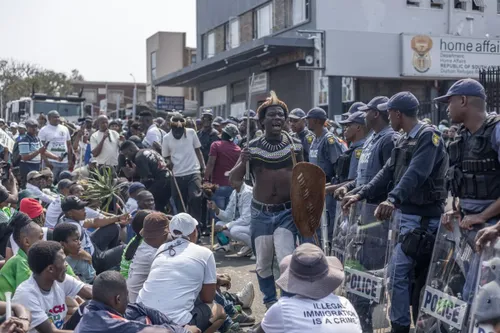
The case has drawn attention to a broader pattern: foreign-owned “spaza” shops are increasingly being targeted within a growing extortion economy that also touches sectors like construction and nightlife. These immigrant-run stores were already in the spotlight earlier this year, when a wave of xenophobic unrest led to widespread looting, arson, and forced closures amid protests calling for undocumented foreign nationals to leave the country.
Advertisements
“The foreigners are the easier targets because they are scared, more scared than South Africans,” said Fransina Lukas, who heads the Western Cape’s community policing forum.
According to Lukas, extortion gangs typically start by sending letters demanding monthly “protection” payments. When shop owners refuse, the response escalates — first “runners” are sent to rob the business, then customers are harassed, and in the worst cases, violence turns lethal.
A pattern of violence
In July, a shooting at a spaza shop in the scenic town of Franschhoek left four people dead, including at least two foreign nationals. That same month, a 31-year-old Somali shopkeeper was shot dead while serving customers in Cape Town’s Bonteheuwel area. Police have linked both incidents to extortion rather than to the earlier wave of xenophobic violence, which authorities say claimed the lives of at least four foreign nationals.
Targeting Khayelitsha’s shop owners
In the sprawling township of Khayelitsha, Somali-run spaza shops are especially targeted, though local shop owners aren’t spared either, according to community leader Mawande Jara. He said extortionists sometimes request bank statements to gauge how much a shop owner can afford to pay, with fees varying based on income.
Much of this crime goes unreported, Jara explained, because victims fear retaliation and suspect that some police officers may be feeding information to the criminal gangs. “If you report them to the police, then in no time these guys are aware that you’ve lodged a case against them,” he said, adding that doing so puts victims’ lives at risk.
In another case, a Cape Town Islamic school and mosque was approached in June by men demanding a 3,000 rand “registration fee” (roughly $180), followed by monthly instalments of 500 rand. A representative of the centre, speaking anonymously, said no direct threats were made but that he’d been warned the men behind the demand were dangerous — and suspected the centre was targeted partly because its imam is a foreign national. The centre reported the incident to police after paying the initial fee.
A booming, underregulated racket
Organised crime investigator Chad Thomas said the use of hired enforcers is sometimes a way for business owners to settle disputes outside a slow-moving civil court system, and that frustration with that process is fueling the rise in this type of extortion.
Police statistics show the Western Cape accounted for nearly half of the 112 protection-racket extortion cases registered nationwide between April and June this year, along with the highest number of spaza shop murders — 30 of the national total of 76. The province is also South Africa’s gang-violence hotspot, recording 217 gang-related murders over the same three-month period, far outpacing any other region.
“Extortion crime has increased exponentially in the last few years,” acting police minister Firoz Cachalia told reporters in June, acknowledging that authorities are still searching for effective solutions. “I don’t think that we have all the answers yet to deal with extortion,” he said. “It’s gone on for a long time on a small scale… (now) It’s really exploding.”
Advertisements