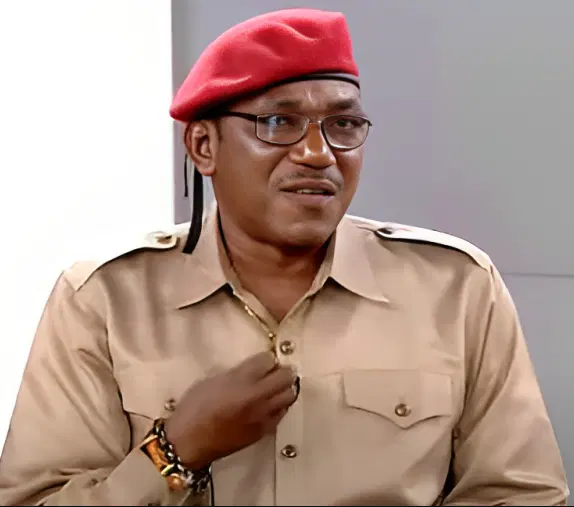
Former Minister of Sports, Barr. Solomon Dalung, has launched a scathing attack on the Tinubu administration, accusing it of lacking the political will to confront the escalating wave of terrorism and banditry consuming the country, and of being more consumed by electoral calculations ahead of 2027 than by the daily loss of Nigerian lives.
Advertisements
Speaking Friday on Arise Television’s Morning Show, Dalung — who served in the cabinet of the late President Muhammadu Buhari under the All Progressives Congress — offered a sweeping indictment of President Bola Tinubu’s three-year record on security, the economy, and political governance.
Advertisements
“Government seems not to have the political will to deal with it,” he said. “They have all the gadgets to track anybody who criticises the government — they can pick him up in the next five minutes. But they don’t have equipment to track terrorists who display huge phones in the forest, behead teachers, abduct schoolchildren, torture them in the forest, produce videos and send.”
Dalung reserved particular contempt for a recent statement by the Minister of Information urging Nigerians to unite against terrorism, describing it as “uncalled for,” “an embarrassment,” and “demoralising” — a confession of state failure dressed up as a rallying cry.
“I think it’s a statement confirming that the federal government has completely and woefully failed,” he said. “They don’t seem to have any idea of a solution to the ravaging insecurity that is across the country.”
The former minister identified two structural failures at the heart of the government’s ineffectiveness: the absence of political will and a chronic lack of coordination among security agencies. He argued that the intelligence community, the military, and allied agencies operated in isolation, each “scrambling for relevance to access the president” rather than pooling intelligence and mounting a unified campaign against insurgents.
He further warned that terrorist groups had effectively established a self-sustaining parallel economy in Nigeria’s forests, rendering them independent of state pressure, and questioned the tangible impact of American military personnel whose presence in the country has been publicly confirmed.
“We were told that the Americans are here with us,” he said. “If the Americans are here with us, what have they been doing? We have not felt their impact.”
On the political horizon, Dalung expressed deepening disillusionment with the country’s ruling class, warning that Nigeria had reverted to the fractious regional politics of the First Republic, with nearly every geopolitical zone now fielding its own presidential aspirant ahead of 2027.
“Almost all the zones have presidential candidates,” he said. “So ultimately, in 2027, we may be facing serious confusion as we advance towards election.” He added that the north-central zone would once again prove the decisive battleground for electoral outcomes.
Turning to Tinubu’s overall record, Dalung was unsparing: “Three years into his tenure, it is just blame game and rhetorics of reforms — reforms that no single iota of the benefit has trickled down. Rather, Nigerians are getting impoverished daily. The economy is in doldrums. Insecurity remains rhetorical.”
Not everyone on the programme shared his verdict. Political scientist Obafemi George pushed back vigorously, arguing that the administration merited more time and credit for implementing reforms that, while painful, were structurally necessary.
George pointed to Standard & Poor’s upgrade of Nigeria’s sovereign credit rating from B- to B as evidence of stabilising macroeconomic fundamentals, and attributed part of the security deterioration to the withdrawal of French military forces from the Sahel — a development he said created a vacuum that international terror networks were swift to exploit.
“This current administration has confronted insecurity that is higher than the previous administration, spent more, and recorded more successes in combating insecurity,” he said, citing several rescue operations conducted in May across Goza and Katsina as proof of operational progress.
Drawing on broader historical comparisons, George cautioned against demanding transformational results within a single electoral term. China’s poverty reduction miracle, he noted, unfolded over more than four decades beginning in 1979, while Rwanda’s celebrated development under President Paul Kagame represented over two decades of sustained effort. Dubai, he added, began its transformation in 1974 and did not emerge as a global destination until around 2014.
“We should be realistic,” George said. “Even God Almighty that personally took a nation out of Egypt and took them to the promised land — it took God 40 years.” He also pointed to the long-delayed removal of fuel subsidies as a structural wound that had been deferred for more than a decade, arguing that the pain Nigerians now endured was the accumulated cost of decisions a succession of governments had lacked the courage to make.
“If we had removed subsidy 10 to 12 years ago, we won’t be where we are today,” he said. “The decision that President Tinubu has made today is so that in 10 years’ time, we will not sit down like this and be discussing this again.”
Advertisements