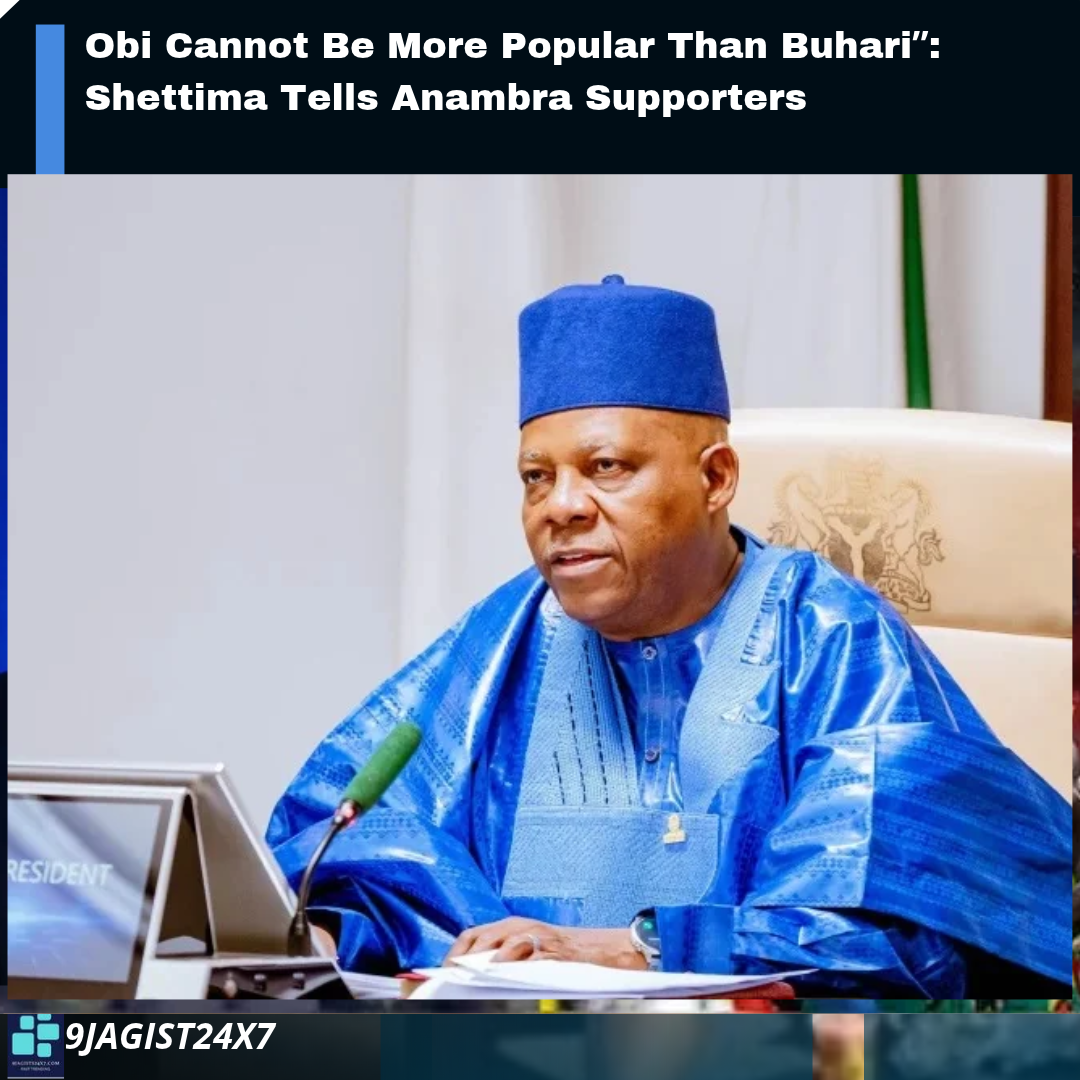
Vice-President Kashim Shettima has said the presidential candidate of the Nigeria Democratic Congress, Peter Obi, cannot be more popular than former President Muhammadu Buhari.
Advertisements
Shettima made the remark at Dr Alex Ekwueme Square in Awka, Anambra State, on Thursday during a campaign rally for President Bola Tinubu.
Advertisements
The event, tagged SoluTinubu 2027, was attended by supporters of the All Progressives Congress and the All Progressives Grand Alliance.
Shettima’s
Shettima said winning a Nigerian presidential election requires more than popularity in one region. He argued that a candidate must build a strong support base across the country.
“Peter Obi cannot be more popular than Muhammadu Buhari,” he said.
He recalled that Buhari contested the presidency in 2003, 2007 and 2011 before winning in 2015, arguing that the former president had a strong base of about 15 million votes in Northern Nigeria.
“Again, he had a strong base of 15 million votes in Northern Nigeria. He tried again in 2011, he lost. Because having a strong base across the nation is what you need to win a presidential election in a country like Nigeria,” Shettima said.
Appeal to the South-East
Shettima urged South-East residents not to allow anyone to tell them that Igbos were not an essential part of Nigeria’s political configuration.
He claimed that about 17 million Igbos live in Northern Nigeria, while about 10 million live in Lagos alone.
The Vice-President said the South-East should be firmly connected to what he described as the “national grid in the federation” through support for Tinubu at polling units.
He also said Anambra would be a key state for the APC in the 2027 election.
Shettima’s statement is a political claim, not an independent measure of Obi’s popularity. Obi finished third in the 2023 presidential election but won the Federal Capital Territory and performed strongly in several states, particularly across the South-East and parts of the South-South.
His support base is often associated with younger voters, urban centres and the Labour Party’s 2023 campaign, although he is now the NDC presidential candidate.
Whether Obi can match Buhari’s former regional strength will depend on his ability to build alliances, secure party structures and expand support beyond his traditional strongholds.
Shettima’s remarks reflect the APC’s strategy of framing the 2027 contest around broad national coalition-building rather than regional enthusiasm alone.
For Obi, the challenge is to demonstrate that his support can translate into votes across the North, South-West, South-South and South-East.
For Tinubu, the task is to retain his existing coalition while making further inroads into the South-East, where Obi remains a major political force.
Advertisements