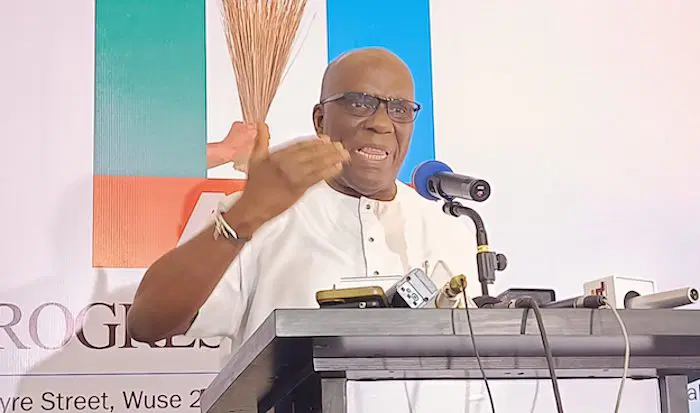
The All Progressives Congress, APC, has pushed back against African Democratic Congress presidential candidate Atiku Abubakar’s call for the Tinubu administration to reduce petrol prices, with National Publicity Secretary Felix Morka arguing that Atiku has yet to articulate a concrete policy alternative of his own. Morka made the comments on Channels Television’s Politics Today on Friday, responding to Atiku’s press conference in Abuja urging the government to ease the rising cost of living.
Advertisements
The APC’s framing
Advertisements
Morka argued that as a declared presidential candidate, Atiku owes Nigerians a clear plan of his own rather than commentary directed at the sitting president, describing his intervention as political posturing without substance. He also raised what he characterized as an inconsistency: that Atiku backed the removal of the petrol subsidy during the 2023 campaign before criticizing the same policy once the Tinubu government implemented it. On the electricity subsidy phase-out planned from 2027, Morka further questioned why Atiku is now proposing measures on power-sector reform that he did not implement during his own tenure as Vice President.
Atiku’s case
Atiku’s underlying argument, as reported, is that rising energy and transportation costs are compounding financial strain on Nigerian households, workers and businesses, and that the government should adopt any policy capable of lowering the cost of living “regardless of who proposed it.” He has separately offered to share his own policy framework with the administration and opposed the planned 2027 electricity subsidy phase-out, warning that the fallout from petrol subsidy removal should not be repeated in the power sector.
The political-contest angle
The exchange sits inside a wider pre-2027 sparring match between the APC and opposition figures over economic management, playing out alongside related developments — including Atiku’s claim, reported separately, that the government is repackaging his own subsidy ideas without crediting him. Seen this way, both sides’ statements function less as policy debate and more as early positioning ahead of the 2027 election cycle.
Advertisements