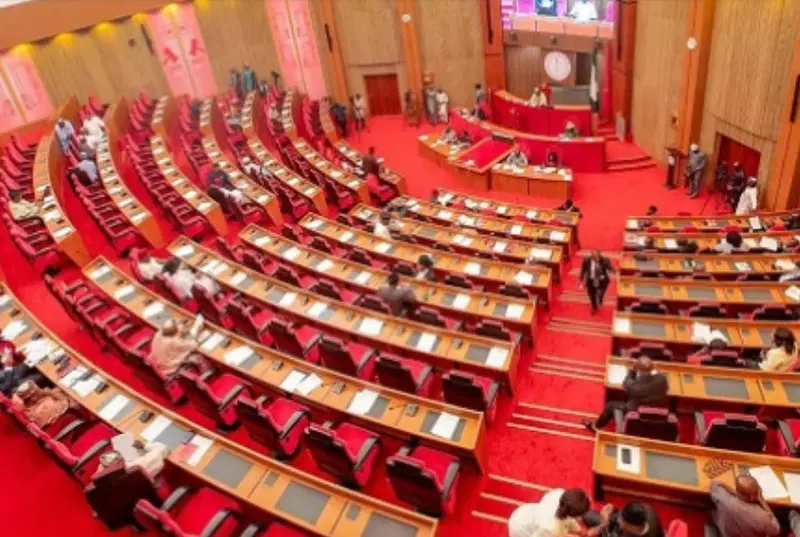
The Senate on Wednesday passed a landmark constitutional amendment bill establishing state police services nationwide, marking a major step in Nigeria’s long-running efforts to decentralise policing and strengthen internal security.
Advertisements
The bill, titled “A Bill for an Act to Alter the Constitution of the Federal Republic of Nigeria, 1999 to Provide for the Establishment of State Police and Related Matters (Sixth Alteration) Bill, 2026 (SB. 1055)”, was approved during consideration by the Committee of the Whole, presided over by Senate President Godswill Akpabio.
Advertisements
With its passage, the legislation replaces the existing Nigeria Police Force framework with a dual structure comprising a Federal Police Service and State Police Services.
The bill creates a constitutional basis for state policing, including the establishment of state police commissions, while retaining the federal police structure in every state until a state police service becomes operational.
Under the new arrangement, the Federal Police Service will be responsible for federal offences, security within the Federal Capital Territory (FCT), national security matters, interstate crimes and organised criminal activities.
State police services, on the other hand, will be charged with local law enforcement, maintenance of public order and protection of lives and property within their respective states.
According to the President, the proposed legislation is designed to provide a legal framework for a dual policing structure, enabling states to establish and operate their own police services alongside the federal police.
The Senate, however, adopted a manual voting process after electronic voting devices failed to function despite repeated attempts to activate them for more than 30 minutes.
The decision followed a motion moved by Senate Leader Bamidele and seconded by Senate Minority Leader Abba Moro (PDP, Benue South), after efforts to test-run the electronic voting system proved unsuccessful.
Senators subsequently voted by raising their hands to indicate their positions on the bill.
Advertisements