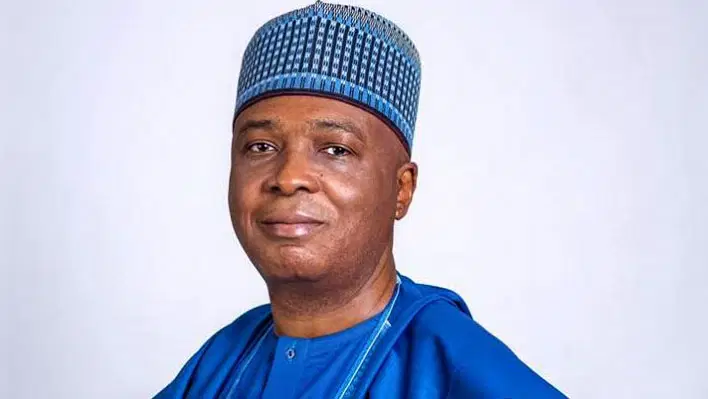
Former Senate President Bukola Saraki has issued a stirring defence of the National Assembly’s role as the “load-bearing wall” of Nigeria’s democracy, arguing that the legislature must be strengthened and protected if the nation is to avoid a repeat of the June 12, 1993 tragedy.
Advertisements
Speaking at The Platform Nigeria, organized to celebrate Democracy Day, Saraki opened his address by invoking the significance of June 12—a date, he said, “the Nigerian state preferred to forget.”
Advertisements
“For a long time, this date was deliberately left out of the calendar of national memory. But yet, the people would not let it die. Year after year, citizens kept faith with its meaning,” the former Senate President said. He recalled the day in 1993 when Nigerians “of every tongue, faith and every region walked out to the polls and spoke with one astonishing voice.”
Annulment of Historic Mandate
That mandate was annulled, he noted. “Lives were lost defending it. A man went to prison for it and never came home. But the idea survived,” Saraki declared.
“And today we stand on Democracy Day, which exists only because ordinary Nigerians refused to surrender their belief in the ballot.”
Saraki opened his address deliberately with the June 12 analogy because, he said, “Everything I will say in this hour flows from a single truth: democracy in Nigeria was never handed to us. It was fought for. And what is fought for must be cherished, protected, built upon. Otherwise, it will be lost.”
Three Pillars of Legislative Importance
The former Senate President, who led the National Assembly’s upper chamber from 2015 to 2019, then made his case for the legislature under three headings: how it secures democratic stability, how it strengthens governance, and how it drives national development.
‘Friction Is Not Dysfunction’
Saraki acknowledged that Nigerians often misunderstand the relationship between the executive and legislative arms of government.
His words: “When Nigerians think of power, they think of one office — the president. This is the reality.
The presidency dominates our imaginations so completely that we sometimes speak as though government is the president, as though the National Assembly is just a nuisance of an institution to be managed, and the courts an obstacle to be circumvented.”
But the framers of the Constitution, he argued, understood something profound.
“The greatest danger to a free people is not a weak government, but an unchecked government. Power that answers to no one. Authority that cannot be questioned.”
Saraki stressed that the separation of powers was deliberate: “They built friction into the system. It was on purpose. It was not a mistake. That friction is not dysfunction. That friction guarantees your freedom.”
He offered a stark warning: “A legislature that cannot say ‘no’ is not a legislature at all.
Our task for this new generation is to ensure that institutions are strong enough to outlast strong men. By insisting that the legislature is independent, transparent, capable, and close to the people. Democracy is not a single election or a single office. It is a daily act of tending to it and ensuring it survives.”
He ended with a simple formula: “A strong legislature promotes transparency. Transparency inspires public trust. Public trust strengthens democratic legitimacy. And democratic legitimacy produces stability. That, ladies and gentlemen, is how we will have a better and stronger democracy.”
Advertisements