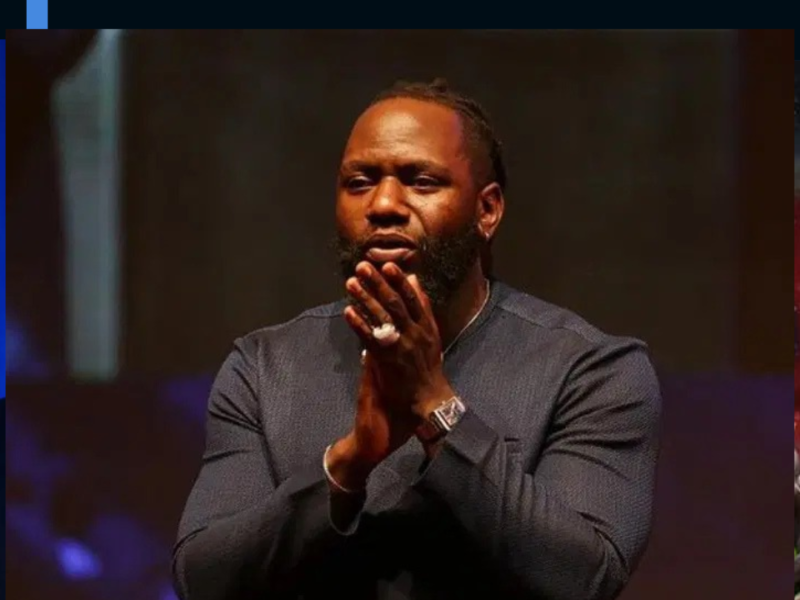
Social media commentator Martins Vincent Otse, popularly known as VeryDarkMan, has tackled actress-turned-evangelist Tonto Dikeh over her recent teaching about the visit of the wise men to Jesus.
Advertisements
In a video shared online on Sunday, November 22, 2026, VeryDarkMan disputed Dikeh’s claim that three wise men visited Jesus after his birth.
Advertisements
“Una mama no be God call am,” he said in Pidgin, questioning the basis of her teaching and her calling as a preacher.
Dikeh, who has publicly embraced Christian ministry, reportedly taught that three wise men visited Jesus, a familiar Christmas tradition.
The account is commonly associated with the Magi in the Gospel of Matthew, although the Bible does not specify their number.
VeryDarkMan challenged her explanation and asked which Bible her teaching was based on.
The Gospel of Matthew records that wise men from the East came to Jerusalem asking where the child born king of the Jews could be found. They followed a star, met King Herod, and later presented gold, frankincense and myrrh to Jesus.
But Matthew does not say there were three wise men. The number three comes from later Christian tradition, likely because three gifts are mentioned
“We do not know if it was a trio of travellers or if there were two or 10,” one biblical scholar noted in a CBN explainer. “But we do know that they came in search of Christ.”
The Bible also does not call them kings. The Greek word used in Matthew is magoi, usually translated as “wise men” or “Magi.
So on the specific question of whether Scripture says “three wise men,” VeryDarkMan’s objection is biblically accurate: the number is tradition, not an explicit biblical detail.
VeryDarkMan did not stop at correcting the number. He also questioned whether God called Dikeh into ministry, using a personal insult that has drawn criticism from her supporters.
That is a different claim altogether. The Bible’s silence on the number of wise men does not establish whether Dikeh has a genuine calling, and a public critic cannot determine a person’s faith or divine commission.
Dikeh has previously responded to criticism of her ministry by saying she would not be silent about the gospel, even if she is mocked.
Celebrity evangelism has become a major feature of Nigerian public life, with actors, musicians and influencers moving into preaching, prophecy and online ministry.
That visibility brings scrutiny. When a celebrity preacher makes a factual claim about Scripture, it is fair for listeners to ask whether the claim is biblically grounded.
But theological correction should not become a vehicle for ridicule. Nigerians deserve teaching that is accurate, and public critics should distinguish between a factual error and a personal attack on someone’s faith.
The “three wise men” debate is a useful reminder that popular Christmas traditions are not always explicit biblical statements.
It is also a reminder that Bible teaching should be tested against Scripture, not against the confidence or celebrity of the person delivering it.
At the same time, disagreement over doctrine should be handled with care. Correcting a detail is not the same as mocking a person’s relationship with God.
Advertisements