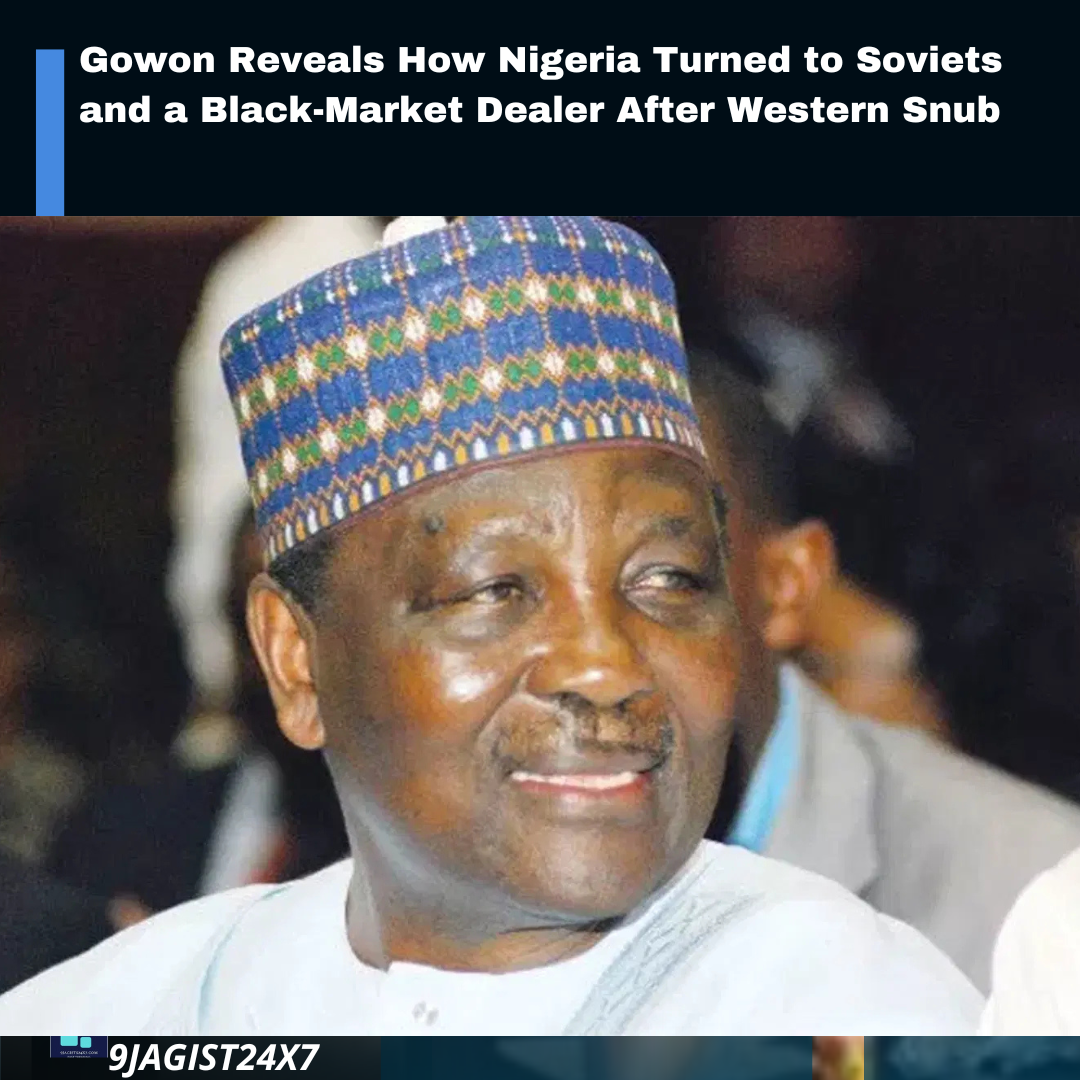
Former Nigerian Head of State Yakubu Gowon has opened up about one of the most desperate chapters of the Nigerian Civil War revealing that the refusal of the United States and Britain to sell arms to Nigeria left him with no choice but to seek weapons from the Soviet Union and a Lebanese black-market businessman.
Advertisements
Gowon made these disclosures in his newly launched autobiography, My Life of Duty and Allegiance, a 859-page, 36-chapter account of his life published by the Havilah Group, Lagos. The book was unveiled in Abuja on Tuesday, with Vice President Kashim Shettima representing President Bola Tinubu at the event.
Advertisements
Running Out of Bullets
In a chapter pointedly titled “If The Devil’s Ready To Help,” Gowon describes a crisis point in late 1968 when the Nigerian Army’s ammunition stockpile had fallen to roughly half a million rounds a dangerously low figure for an active warfront. Western nations had imposed restrictions on arms sales to Nigeria, effectively cutting off the federal forces from their usual supply chains.
With supplies dwindling, Gowon was forced to halt troop advances after the capture of Enugu, holding positions at Okigwe and Umuahia rather than push further into enemy territory without adequate firepower to back his men.
A Blunt Warning to Western Ambassadors
Gowon summoned the British and American ambassadors to what he described as one of the most pivotal meetings of the entire war. Both countries were, at the same time, deepening their own military operations in Vietnam and Cambodia a fact that clearly stung him.
He told the ambassadors plainly that he would go to “any devil” to get what his country needed, and warned that he hoped no one would fault him for doing so when that moment came. The ambassadors departed without offering any commitments.
The Soviet Connection
With Western doors firmly shut, Gowon directed his Principal Secretary, Hamza Ahmadu, to reach out to Soviet Ambassador Aleksandr Romanov. A Nigerian delegation comprising Anthony Enahoro, Edwin Ogbu, Emmanuel George Kurubo, and Ambassador John Ukegbu was subsequently sent to Moscow.
The mission proved successful. The Soviet Union supplied Nigeria with MiG-15 trainer aircraft and MiG-17 bombers, a development Gowon credits with helping to shift the momentum of the war. He notes that the relationship between Nigeria and the Soviet Union grew into something distinctly close in the years that followed, rooted in that wartime solidarity.
The Lebanese Businessman Who Stepped In
Beyond the Soviet deal, Gowon also credits a Lebanese businessman named Ali Jamal with playing a crucial behind-the-scenes role. When the Nigerian government lacked the immediate funds to pay for urgently needed arms and ammunition, Jamal reportedly offered to finance the purchases himself interest-free on the understanding that he would be reimbursed as quickly as possible.
His trust in Nigeria’s word proved pivotal. The supplies Jamal helped procure, Gowon writes, materially changed the course of the war.
A Cabinet Clash Over Payment
The arrangement, however, sparked a significant internal disagreement. Then Finance Commissioner Obafemi Awolowo refused to authorise payment to Jamal, arguing that due process had not been observed and that the spending fell outside the approved budget.
Gowon was furious, saying he felt his cabinet colleagues had failed to grasp the severity of the crisis facing Nigerian troops in the field. He ultimately invoked his authority as Head of State to override the objection and ensure Jamal was paid in full.
Reflecting on the clash years later, Gowon said he remained proud of a team that held firm on due process even in extraordinary circumstances even as he had to use the weight of his office to cut through the bureaucratic deadlock.
The autobiography traces Gowon’s full journey from his early years in Plateau State through his military career, the civil war, his removal from power in 1975, and his subsequent years in exile and academic life.
Advertisements