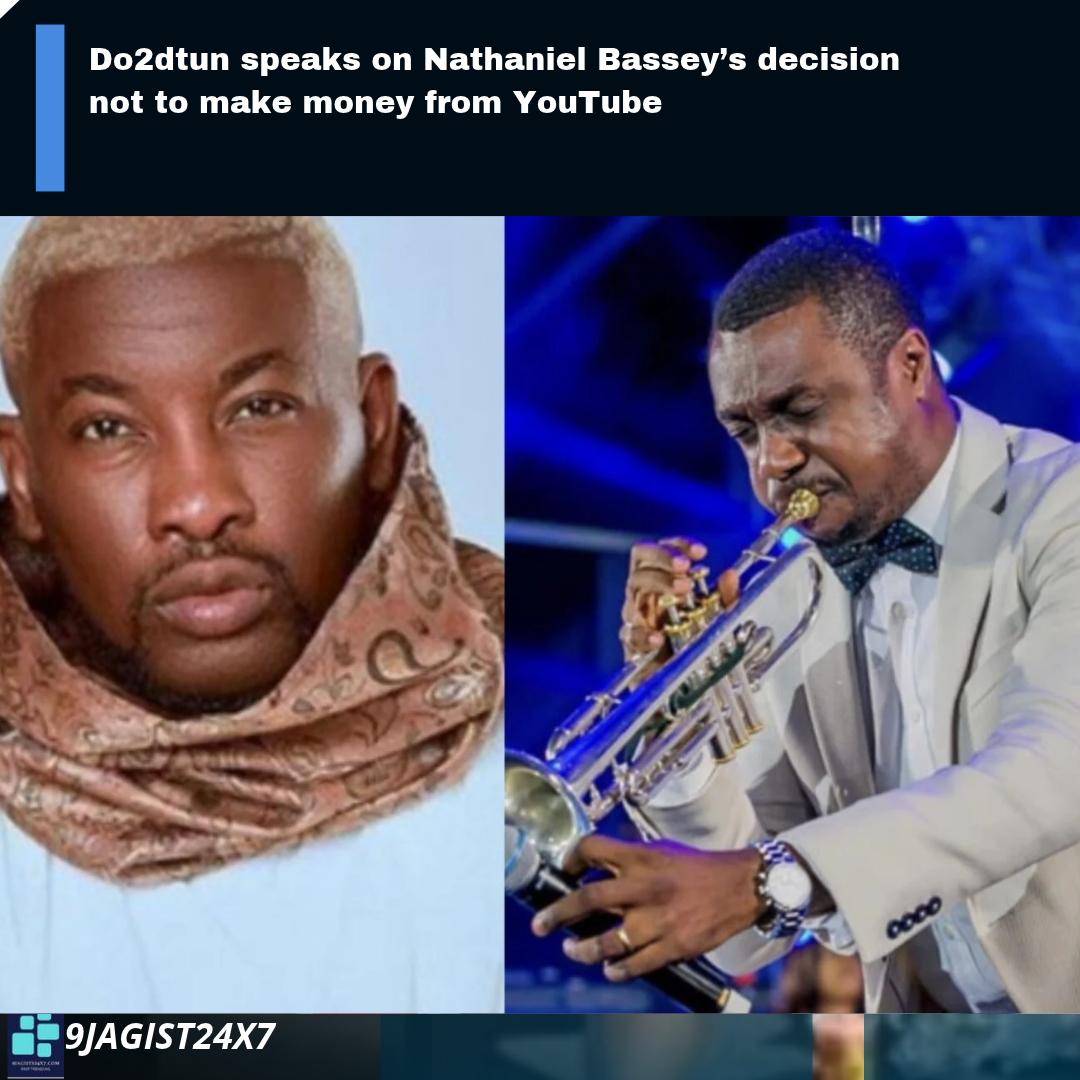
Media personality Do2dtun has praised gospel singer Nathaniel Bassey for refusing to monetise his YouTube channel, even after the platform surpassed one billion all-time streams. In a post on X, Do2dtun described the decision as an act of humility, arguing that Bassey built the channel to win souls rather than generate daily income.
Advertisements
The praise came after Bassey’s official YouTube channel crossed the one-billion-stream milestone, a remarkable achievement for a gospel musician whose online presence has become a major global worship destination. Do2dtun said the singer’s choice stood out because the platform could have produced “cool money” every day, yet Bassey chose to keep it focused on ministry.
Advertisements
Do2dtun’s comments centred on the purpose behind Bassey’s channel. He said the gospel minister created the platform with one clear objective: evangelism. In his view, that purpose explains why Bassey has not turned its enormous traffic into advertising revenue.
“He creates a platform to win souls; he does it with the utmost humility,” Do2dtun wrote. He added that Bassey created a channel that could have earned substantial daily income but chose not to monetise it.
For Do2dtun, the decision reflects selflessness. A billion streams represents not only a huge audience but also an enormous commercial opportunity. Many creators would treat such traffic as a business asset, using advertisements, sponsorships, memberships, and merchandise to convert attention into income. Bassey’s decision to leave the channel unmonetised therefore sends a strong message about what he considers the platform’s true value.
Bassey’s YouTube growth has been driven largely by the Hallelujah Challenge, his midnight praise and worship programme. The initiative has drawn participants from different parts of the world, turning the channel into more than a place to watch music videos.
The Hallelujah Challenge has become a recurring online gathering where people join live worship, prayer, and praise sessions. Its global reach has helped Bassey build a community that returns repeatedly, rather than relying only on occasional music releases. That repeated engagement is one reason the channel has been able to accumulate such a large number of streams over time.
The programme also demonstrates how digital platforms can reshape religious life. A worship service that once required physical attendance can now reach viewers across time zones, allowing people to participate from their homes, workplaces, or wherever they have internet access.
Supporters of Bassey’s decision argue that keeping the channel unmonetised protects its spiritual purpose. If the platform is primarily meant for worship and evangelism, advertisements could interrupt the experience or create the impression that ministry is being used for profit.
There is also a symbolic dimension. A billion-stream channel that generates no advertising revenue challenges the assumption that every large online audience must be converted into money. For some viewers, Bassey’s choice reinforces the credibility of his message because it suggests that his primary motivation is ministry rather than financial gain.
Do2dtun’s praise reflects that view. By highlighting Bassey’s humility, he framed the singer’s decision as rare in an era when creators are often encouraged to maximise every possible revenue stream.
Not everyone agrees that leaving the channel unmonetised is the best use of its success. Some social-media users argued that advertising revenue could be used for charitable work, including support for widows, orphans, rural health centres, and job creation.
That argument raises a practical question: if a platform can generate significant income, could that income do more good when directed toward humanitarian projects? For critics of the decision, monetisation would not necessarily contradict Bassey’s faith. Instead, it could expand his capacity to fund outreach, welfare programmes, and community support.
Others simply urged the singer to benefit from the success of his own work. They see nothing wrong with a creator earning income from content that people voluntarily watch, especially when that content requires production, planning, and consistent effort.
The discussion around Bassey’s channel reveals a broader tension in modern ministry and content creation: should spiritual platforms remain free of commercial income, or should they use commercial tools to fund a larger mission?
There is no single answer. Some believe that accepting advertising money risks changing the tone and priorities of a ministry. Others believe that refusing available resources may limit the scale of charitable work a ministry could otherwise support.
Bassey’s decision suggests that he sees the platform’s spiritual impact as more important than its earning potential. Do2dtun’s praise reinforces that interpretation, presenting the unmonetised channel as evidence of humility and a clear sense of purpose.
Crossing one billion streams is a major achievement for any creator, but it is especially notable for a gospel artiste. It shows that worship music and online ministry can command a global audience without relying on mainstream celebrity culture or commercial promotion.
The milestone also raises questions about how success should be measured. In a digital economy dominated by views, clicks, and revenue, Bassey’s unmonetised channel offers a different model. Its value is not measured by advertising income but by the people who gather online to worship, pray, and participate in the Hallelujah Challenge.
Whether Bassey eventually chooses to monetise the platform may depend on how he balances ministry, sustainability, and the potential to fund wider charitable work. For now, his decision has become a talking point about faith, humility, and the true purpose of digital influence.
Advertisements