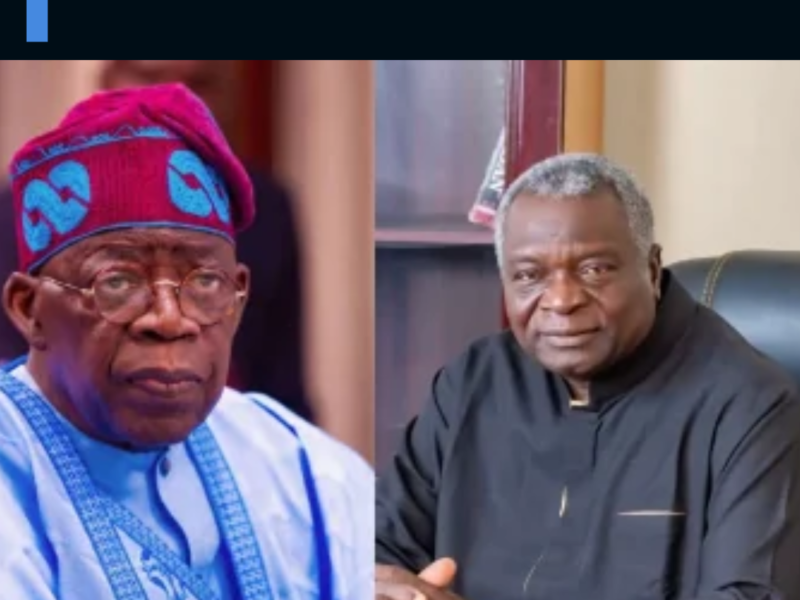
Former Rivers State Governor Rotimi Amaechi has challenged Senator Adams Oshiomhole to present his academic certificates after the former Edo State governor described him as “shallow.” The exchange has turned a political disagreement into a public debate about credentials, credibility, and the personal attacks that often shape Nigeria’s political discourse.
Advertisements
Amaechi issued the challenge during an interview on Rapid TV while responding to Oshiomhole’s criticism of his political positions and credibility. Oshiomhole had accused Amaechi of being unreliable and inconsistent, arguing that the former Rivers governor was now attacking the All Progressives Congress and President Bola Tinubu after previously supporting them.
Advertisements
What Oshiomhole Said
Oshiomhole’s criticism went beyond Amaechi’s political views. He questioned Amaechi’s relationship with former Vice-President Atiku Abubakar, the African Democratic Congress presidential candidate, recalling that Amaechi had previously challenged Atiku’s emergence as the Peoples Democratic Party presidential candidate.
According to Oshiomhole, Amaechi once described the primary that produced Atiku as fraudulent and even went to court over the outcome. He alleged that Amaechi later changed his position after Atiku approached him to work together.
Oshiomhole also suggested that Amaechi’s current opposition to the APC and Tinubu contradicted his earlier political alignment. In his view, that inconsistency undermined Amaechi’s credibility as a critic of the ruling party.
Amaechi’s Response
Amaechi said he was disappointed by the remarks and rejected the suggestion that he was politically inferior to Oshiomhole. He argued that the two men were equals because they both served as governors at the same time.
“He’s not my subordinate. We are equals. He was governor while I was governor. So he’s not my subordinate,” Amaechi said.
He then shifted the debate to education. Amaechi said he holds degrees in Law and Literature, master’s degrees in both fields, a certificate from the University of London, and a master’s degree from King’s College London. He added that he is pursuing a master’s degree in Global Political Economy.
“Tell him to show his certificate,” Amaechi said, directly challenging Oshiomhole to make his own academic credentials public.
Amaechi’s response turns the argument from political disagreement into a question of personal qualification. By listing his academic background, he is attempting to counter the “shallow” label with evidence of formal education and intellectual preparation.
The challenge also reflects a familiar pattern in Nigerian politics, where disputes between senior politicians often move quickly from policy differences to personal attacks. When one figure questions another’s intelligence or credibility, the response is often to demand proof of educational attainment.
But certificates alone do not settle political debates. A politician’s record in office, policy positions, integrity, and ability to deliver results are equally important. Still, Amaechi’s challenge puts pressure on Oshiomhole to respond with more than insults if he wants to sustain the claim that his rival is “shallow.”
Amaechi also linked Oshiomhole’s criticism to their past conflict over the leadership of the APC. He claimed that Oshiomhole was removed as the party’s national chairman because he was incapable of governing the party, and said he led the team that worked for that removal.
“What is paining Oshiomhole is that he was removed as chairman of the party, and I led the team that removed him as chairman of the party because he was incapable of governing the party,” Amaechi said.
That claim adds history to the current confrontation. It suggests that the present exchange is not merely about Atiku, Tinubu, or the 2027 election, but also about an old political rivalry that has resurfaced as both men position themselves in the evolving opposition landscape.
Oshiomhole also questioned Amaechi’s record in Rivers State, alleging that his administration mismanaged public funds and abandoned projects. Amaechi dismissed the accusations as late and false, noting that it took Oshiomhole 12 years to make them.
“It took him 12 years. Nigeria has not asked questions. Twelve years to accuse me and falsely,” Amaechi said.
He argued that Oshiomhole did not raise the allegations when he left office, or one, two, or three years afterwards. In his view, the timing weakens the credibility of the claims.
Amaechi said he would not respond to Oshiomhole again, adding that the senator could continue making whatever allegations he wished.
The confrontation is ultimately about credibility. Oshiomhole is trying to portray Amaechi as inconsistent and politically opportunistic, while Amaechi is attempting to portray Oshiomhole as unqualified to question his intelligence or record.
Their disagreement also reflects the broader tension within Nigeria’s opposition politics ahead of 2027. Former allies are now publicly questioning one another’s motives, alliances, and past decisions, while voters are left to judge who is offering a credible alternative to the ruling party.
For now, Amaechi has made his position clear: if Oshiomhole wants to call him shallow, he should first show his own certificates. Whether Oshiomhole responds to that challenge or returns to the political accusations may determine how long the feud continues.
Advertisements