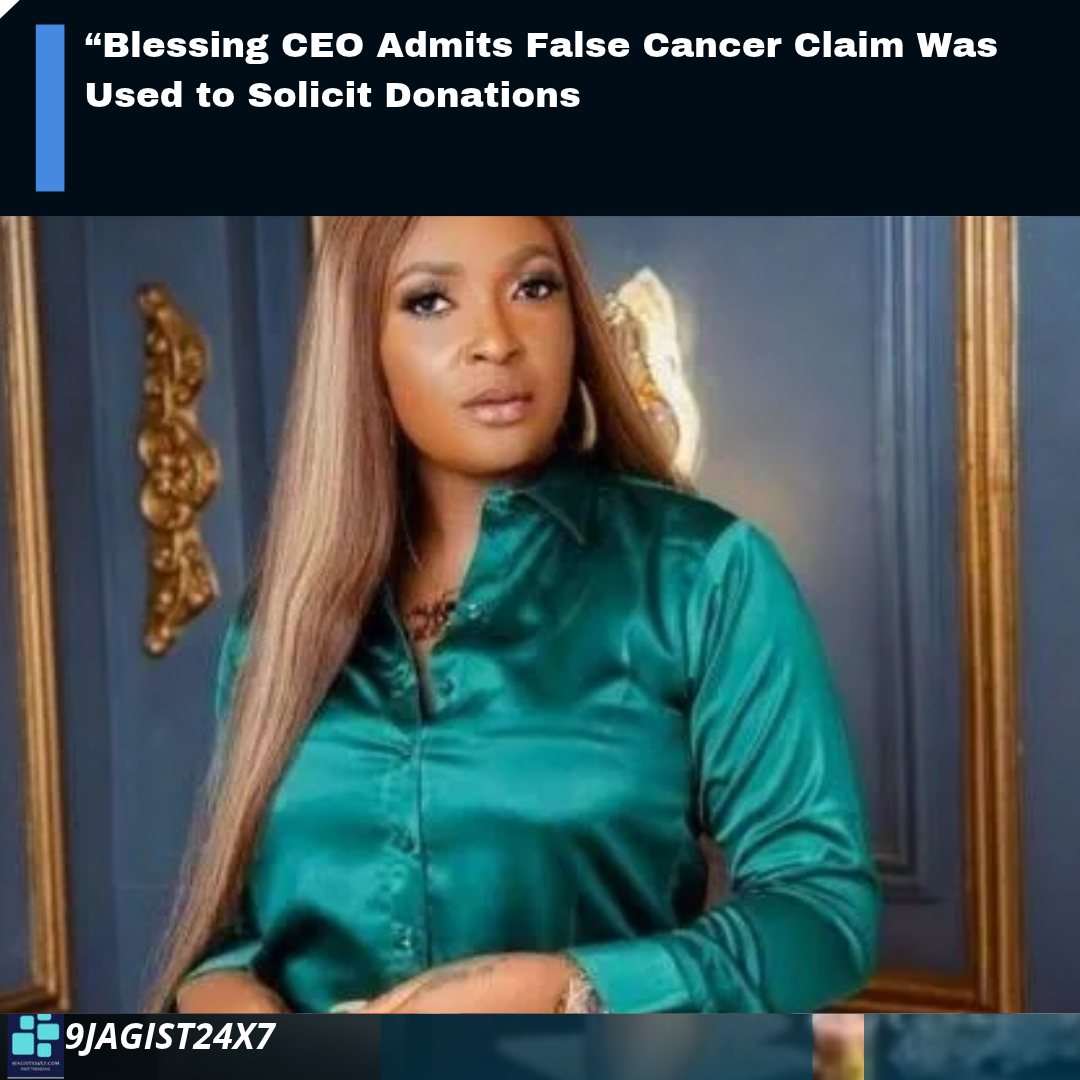
Social media personality Blessing Okoro, popularly known as Blessing CEO, has admitted that she deliberately claimed to have breast cancer in order to attract financial donations from members of the public.
Advertisements
She made the admission during an interview with social-media activist Martins Vincent Otse, popularly known as VeryDarkMan, in a video shared on Thursday.here the cancer drama came in,” she said.
Advertisements
Blessing CEO said she faced financial pressure connected to an Economic and Financial Crimes Commission-related dispute involving a man identified as Dr Onuoha Okeigwe. She said she decided to create a public health crisis to seek help.
What she admitted
The influencer said a medical check-up months earlier had found a lump in her breast, but that the lump was not cancerous.
“Honestly, I do not have cancer,” she said. “The truth is, I had gone for a check-up a few months ago and they found a lump on my breast, but it was not cancerous.”
She admitted that she then told the public the lump was cancerous because she wanted financial assistance.
“So I took advantage of that, came to the media, cried for help and said that the lump was cancerous. I played an emotional game. I wanted funds, but I didn’t come out directly to ask for funds,” she said.
Blessing CEO said she first created the impression that she might sell personal belongings, including her car and house, because of her financial situation.
She said members of the public then encouraged her to share her bank details for donations, after which contributions began coming in from people sending different amounts
According to her, the donations stopped after VeryDarkMan questioned her cancer claim and demanded evidence supporting the fundraising appeal
“When I saw the video, immediately he made that video, the donation stopped. The donation paused,” she said.
She added that she was not proud of her actions.
Earlier denial
The confession reverses Blessing CEO’s earlier position after the controversy began in March, when she announced that she had been diagnosed with breast cancer and sought financial support for treatment.
In April, she told content creator Egungun of Lagos that she had received N13 million in donations but insisted that she owed nobody an apology. She attributed the confusion around her diagnosis to possible miscommunication and said she was still seeking clarification from her doctors.
The Delta State chapter of the Nigerian Medical Association later disowned a histology report circulated in connection with her claims, saying it had originally been issued to another patient, Deborah Mbara, and not Blessing CEO.
EFCC case continues
The Economic and Financial Crimes Commission later arraigned Blessing CEO on a six-count charge bordering on obtaining money by false pretence, forgery and other alleged offences involving N13 million raised from members of the public.
She pleaded not guilty to the charges. The EFCC alleged that she used a falsified medical report to solicit donations, but those allegations remain subject to determination by the court.
The cancer-related matter is one of three fraud cases instituted against her by the EFCC. She is also standing trial over an alleged N36 million property-transaction fraud and an alleged N69.15 million fraud involving a five-year lease of a property in Lekki, Lagos.
Blessing CEO has pleaded not guilty in the separate fraud cases. The criminal case connected to the cancer fundraising controversy was adjourned until January 12, 2027, for the prosecution to call additional witnesses.
The case shows why donors should be cautious before sending money for medical emergencies, especially when the appeal is promoted through social media.
A genuine medical fundraiser should be verifiable: it should identify the patient, hospital or treatment provider, state the amount needed, explain how funds will be used, and provide credible documentation where appropriate.
It also highlights the danger of turning private health information into public spectacle. A lump in the breast can be frightening, but it is not automatically cancer; medical findings should be interpreted and communicated by qualified health professionals
Advertisements