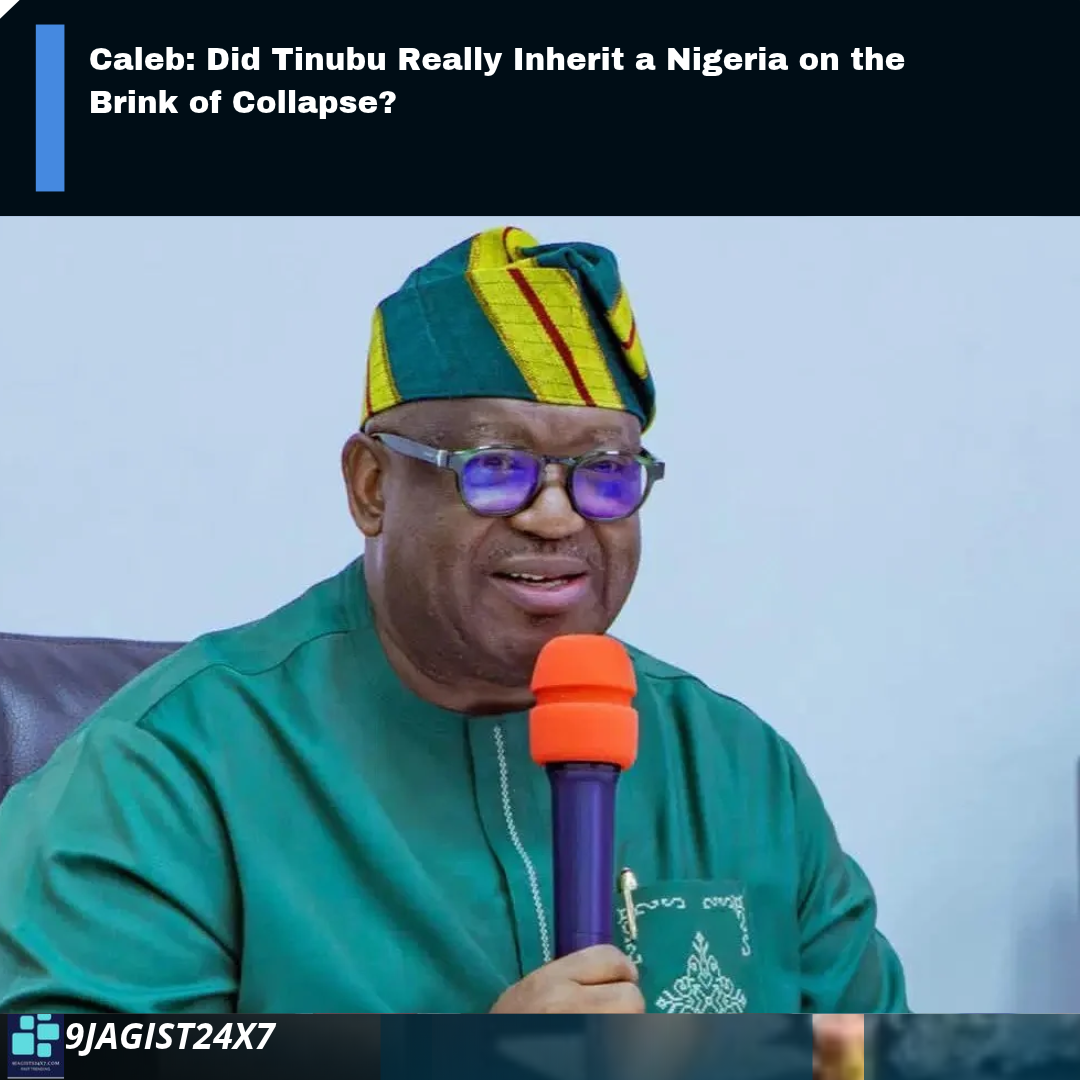
Plateau State Governor Caleb Mutfwang has declared that President Bola Tinubu inherited a country “tottering on the brink of collapse” in 2023, defending the administration’s economic reforms and urging Plateau residents to back Tinubu’s re-election in 2027. Speaking at the formal inauguration of the All Progressives Congress campaign council in Jos, the governor argued that the previous administration left behind severe fiscal, fuel, and foreign-exchange problems that could not be resolved overnight.
Advertisements
Mutfwang’s remarks were both an economic defence and a political rallying call. He insisted that Nigeria’s condition before Tinubu took office justified the difficult adjustments Nigerians have experienced, while also declaring that there is “no vacancy” in Aso Rock or the Plateau Government House ahead of the next general elections.
Advertisements
The Plateau governor framed Tinubu’s inheritance as a nation in deep economic distress. According to him, Nigeria in 2023 could not service its external debts, and foreign businesses struggled to repatriate their proceeds because of dollar shortages. He said the situation became so severe that some international airlines stopped flying to Nigeria because they could not access the dollars needed to take their earnings out of the country.
Mutfwang also claimed that Nigeria’s external reserves had fallen to just over $3 billion, down from more than $40 billion accumulated over decades. He contrasted that figure with what he described as a healthier external reserve position of over $50 billion under the current administration.
The governor further alleged that the Buhari administration resorted to printing money to manage the economy. He claimed that more than N30 trillion was printed through the Central Bank, describing the money as having “gone down the drain.” In his view, the Tinubu administration has since stabilised the Central Bank and addressed that deficit.
Mutfwang directed some of his strongest criticism at the fuel subsidy system operated under the previous government. He described it as fraudulent, alleging that the country borrowed money to pay subsidy claims supported by fictitious documents.
“You cannot continue to borrow money to give to thieves,” he said, arguing that the subsidy regime had to end at some point. He acknowledged that stopping it would create a period of hardship and recovery, but maintained that the reform was necessary.
The governor also claimed that the previous administration sold crude oil in advance, leaving Nigeria to service obligations tied to crude that had not yet been extracted. He said the country was still paying for those arrangements, reinforcing his argument that Tinubu should not be expected to reverse years of economic damage immediately.
Mutfwang admitted that fuel is not cheap, but argued that availability has improved. He recalled periods when Nigerians spent days in long queues at petrol stations and said the current administration had resolved that particular problem.
Plateau’s Response to Hardship
While defending Tinubu’s reforms, Mutfwang acknowledged the burden they have placed on citizens. He said his administration is taking steps to cushion the effects of economic adjustment on Plateau residents.
He cited the introduction of metro buses in Jos and the revival of the railway system within the state capital as examples of measures designed to ease transportation pressures. He also highlighted a 50 per cent reduction in school fees for students in tertiary institutions and an increase in student allowances by about 300 per cent.
The governor praised the federal government’s student financing initiative, NELFUND, saying Plateau indigenes studying in universities have benefited from the scheme. He claimed that hundreds of millions of naira have been disbursed to students from the state, with some receiving monthly payments of N20,000 or N40,000.
Those measures form the core of Mutfwang’s campaign message: that the APC is not only implementing difficult reforms at the federal level but also providing visible support at the state level.
Power Rotation and 2027 Politics
Mutfwang also used the event to make a clear political argument about power rotation. He said Nigeria must respect the arrangement of alternating power between the North and South, arguing that if the North has spent eight years in power, it is only fair to allow the South to do the same.
His comments suggest that he sees Tinubu’s re-election as consistent with a broader rotational understanding, rather than as a break from Nigeria’s political conventions. He warned that failing to respect such arrangements could “come back to haunt” the country in the future.
On the Plateau governorship, Mutfwang declared that there is no vacancy in the Government House. He said the state has agreed to a two-term arrangement per senatorial zone, adding that only if the northern zone chooses not to produce a governor until 2035 could his mandate be challenged.
No Rainbow Coalition
The governor dismissed speculation about a “rainbow coalition” ahead of 2027, insisting that Plateau has chosen to move in one political direction under the APC.
“Some people are talking about rainbow, we are talking about a unification movement,” Mutfwang said. He described the APC as the “wings” on which Plateau people have chosen to fly in the next election, urging party members and campaign officials to mobilise across the state.
His declaration is aimed at countering any suggestion that opposition forces could unite to challenge Tinubu or unseat him in Plateau. By framing the APC as a unification movement, he is seeking to present the party as the natural political home for the state’s diverse communities.
Security and Displacement
Mutfwang did not deny that insecurity remains a major challenge in Plateau. He acknowledged that opponents will point to hunger and persistent violence, saying his administration does not deny those problems.
However, he rejected the claim that his government has done nothing. He argued that insecurity cannot be solved like tap water by simply turning on a tap, but requires deliberate, sustained action. He said his administration understands the issues and has begun proposing solutions in the places that matter.
The governor pledged to protect every part of Plateau State and said practical steps would soon be taken to facilitate the return of internally displaced persons to their communities. He asked residents for patience and trust, promising that they would not regret supporting his administration.
A Campaign Built on Context
Mutfwang’s speech offers a clear defence of Tinubu’s presidency: the president inherited a broken economy, took difficult decisions, and is beginning to stabilise the country. At the same time, it acknowledges the realities of hardship and insecurity, attempting to turn those challenges into a case for patience rather than punishment at the polls.
Whether that argument convinces voters in Plateau and across Nigeria will depend on whether they see enough improvement in fuel availability, food prices, security, jobs, and public services. For now, Mutfwang has made his position unmistakable: Plateau is going APC, Tinubu deserves a second term, and the hardships of reform are, in his view, the price of rescuing a country that was already close to collapse.
Advertisements