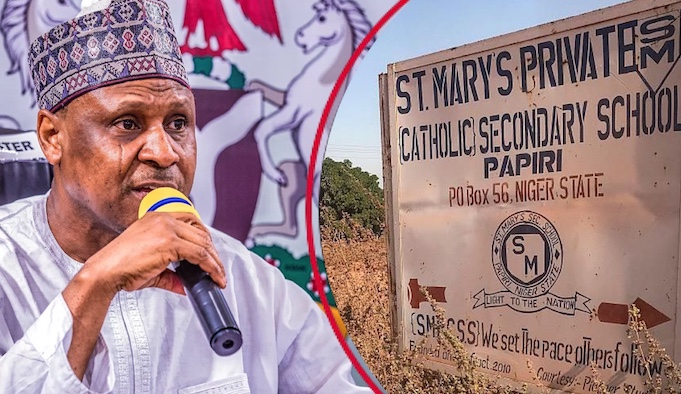
The Federal Government of Nigeria has refuted accusations that it paid a N2 billion ransom to free pupils kidnapped from St. Mary’s School in Papiri, Niger State, calling them “false and baseless.”
Mohammed Idris, Minister of Information and National Orientation, reiterated the government’s long-standing anti-ransom payment stance in a statement released in Abuja on Tuesday. He said that coordinated security operations, intelligence collection, and interagency cooperation—rather than financial inducements—were what led to the students’ release.
The government was reacting to an Agence France-Presse (AFP) article that quoted intelligence sources claiming that up to 230 students and employees who had been kidnapped in November had been freed in exchange for millions of dollars being paid to terrorists and the release of two commanders.
Idris claimed that the AFP report’s credibility was damaged by its reliance on unnamed sources and “contradictions.” The Department of State Services (DSS) had called the assertion “fake and laughable,” he said, dismissing claims that ransom money was flown to rebels in northeastern Nigeria as “fiction.”
“
According to the statement, the federal government claims that these accusations are wholly untrue and unfounded. “No militant commanders were released, and no ransom was paid.”
President Bola Tinubu’s administration highlighted that Nigeria is facing a “structured, profit-driven criminal enterprise” and attributed the students’ safe recovery to expert security efforts.
The opposition Peoples Democratic Party (PDP) demanded complete openness in spite of the denial, cautioning that any direct or indirect ransom payment would be “shameful and troubling” and would give criminal organisations more confidence.
Similarly, the African Democratic Congress (ADC) demanded a detailed security briefing, arguing that inconsistent public communication was fueling suspicion.
The controversy has drawn international notice. Members of the United States Congress reportedly submitted a security brief to President Donald Trump, expressing concern about persistent attacks on Christian communities in parts of Nigeria and urging stronger action against armed groups.
Kidnapping for ransom has evolved into a major security challenge in Nigeria. According to data from Armed Conflict Location & Event Data (ACLED), hundreds of abductions were recorded in the past year alone, many involving multiple victims.
While the federal government maintains that no ransom was paid in the St. Mary’s case, the broader debate highlights ongoing concerns about transparency, counterterrorism strategy, and the effectiveness of Nigeria’s anti-kidnapping laws.