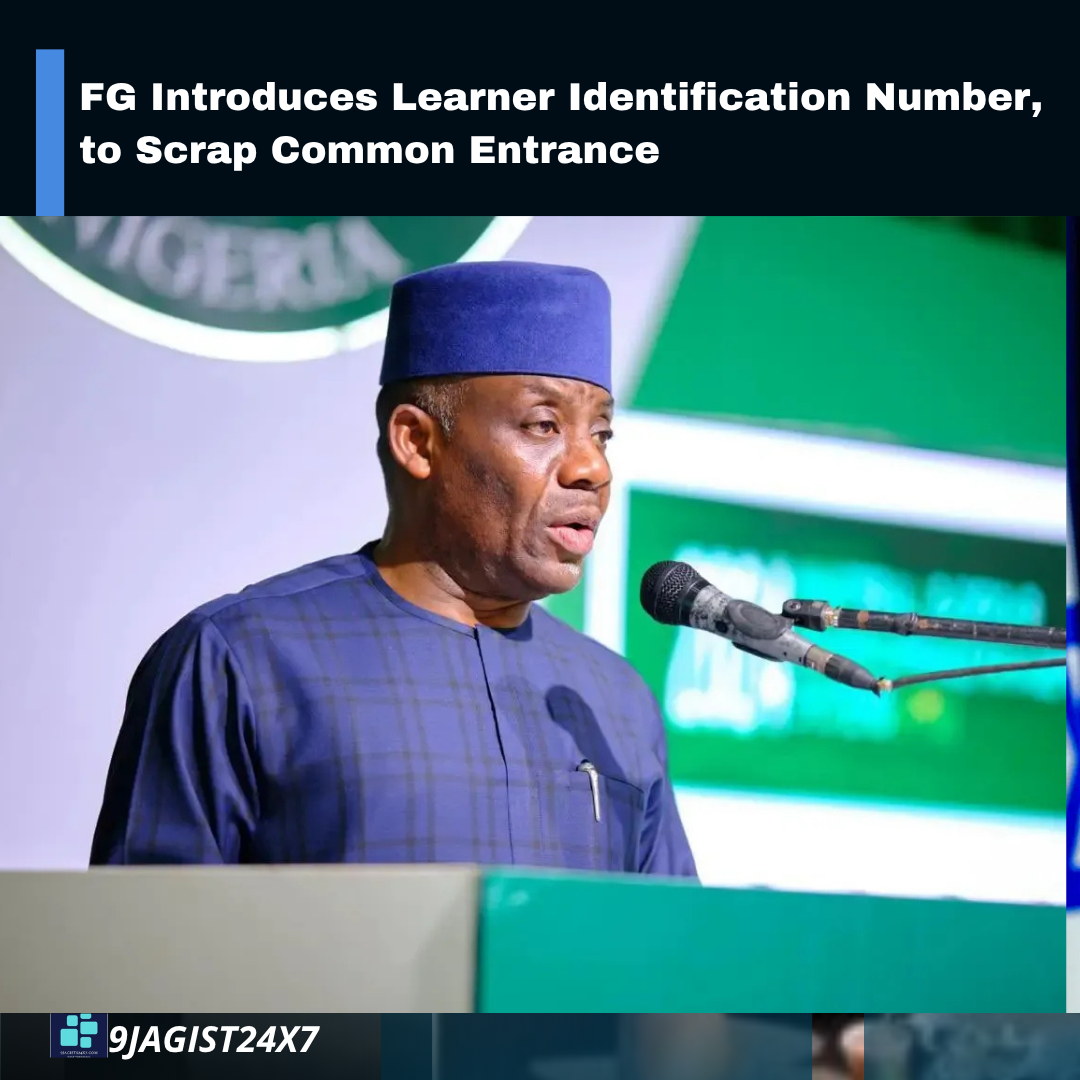
The Federal Government has announced plans to replace the National Common Entrance Examination with a continuous assessment framework backed by a digital student tracking system.
Minister of Education Dr. Tunji Alausa disclosed the new direction during a press interaction in Lagos, with the Learner Identification Number (LIN) sitting at the heart of the reform. This unique digital identifier will be assigned to every student from primary school level onwards.
Dr. Alausa painted a troubling picture of the current state of pupil transitions within the public school system. Of more than 23 million children enrolled across upwards of 50,000 public primary schools nationwide, fewer than 3 million ultimately proceed to public junior secondary schools — a gap the Minister described as deeply alarming.
The LIN, he explained, is designed to close that gap by giving authorities the ability to monitor each child’s educational journey and pinpoint exactly where dropouts are occurring and why.
“If a child is expected to be in JSS1 and is not there, we will know and find out why,” the Minister said.
On the examination front, the government intends to wind down the long-standing Common Entrance Examination and replace it with a Continuous Assessment (CA) model. Under this approach, students will be evaluated on the basis of cumulative performance beginning in Primary One. Crucially, assessment records will be portable — meaning they follow a child from one school to another — ensuring a consistent and complete picture of academic development, rather than one shaped by a single high-pressure test.
Acknowledging the scale of the infrastructure challenge, Dr. Alausa noted that private schools alone cannot absorb the millions of children currently locked out of secondary education. In response, the federal government is working alongside state governments to expand public school capacity through new facility development.
The Minister also flagged plans to revive and restructure the national school feeding programme as a tool for boosting both enrolment and retention. To sharpen oversight and better align the initiative with learning outcomes, management of the programme is set to be transferred from the Ministry of Humanitarian Affairs to the Federal Ministry of Education.
Taken together, Dr. Alausa said, these measures — spanning digital tracking, assessment reform, and infrastructure investment — are aimed at ensuring that no Nigerian child’s educational future is cut short by barriers to access.