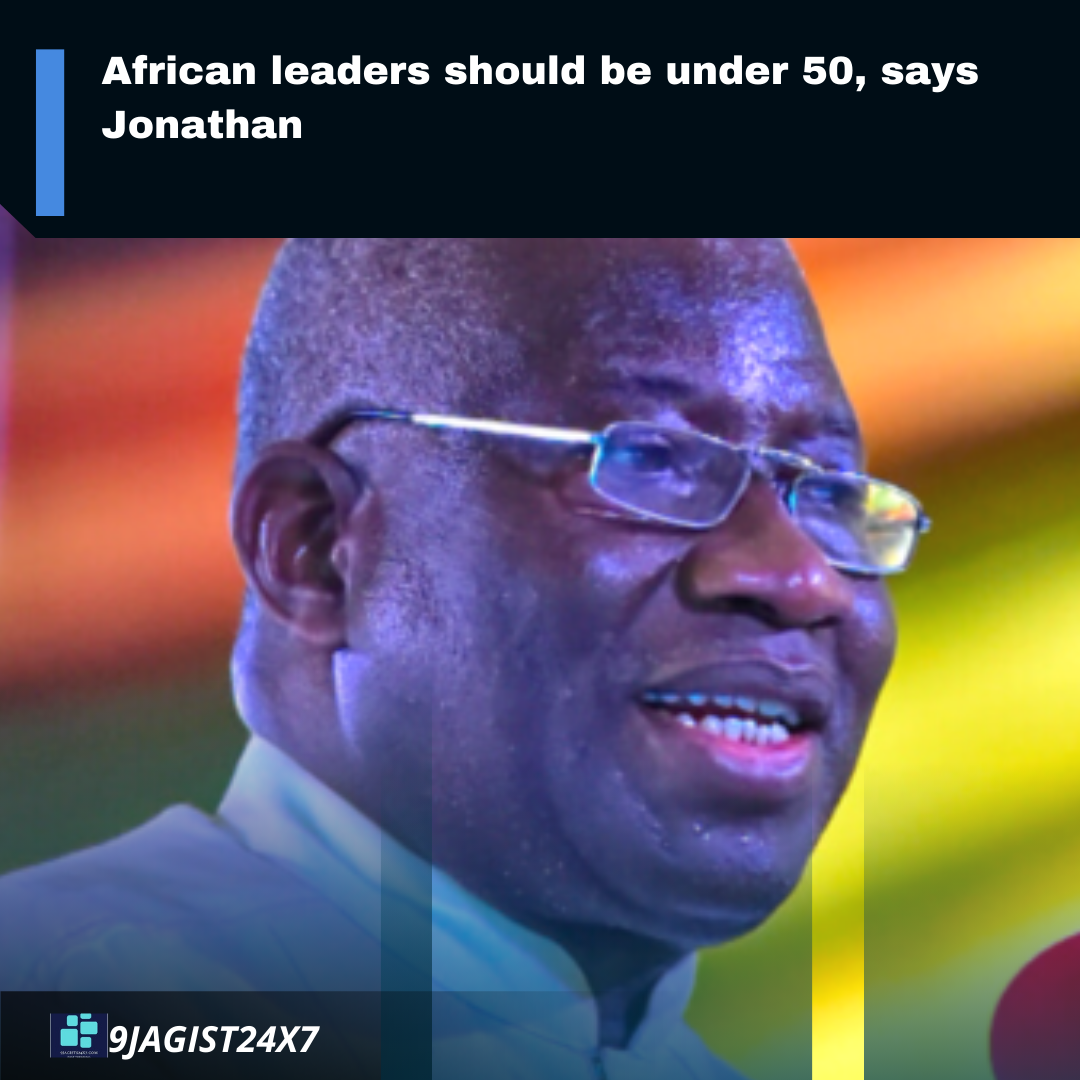
A generational change in African leadership has been advocated by former President Goodluck Jonathan, who claimed that nations on the continent should intentionally elevate younger leaders between the ages of 25 and 50 since they are more prepared both mentally and physically for the demands of contemporary governance.
At the International Memorial Lecture and Leadership Conference in Abuja on Thursday, which commemorates the 50th anniversary of the assassination of former Head of State General Murtala Ramat Muhammad, Jonathan made the call.
The former president emphasised that growing older can reduce one’s ability to handle the duties of leadership by recalling that, during his time in office, he occasionally slept for little more than two hours in a 24-hour period.
“Why do we begin to think that you must be a hundred years old before you can rule your country?” Jonathan asked.
He noted that leadership requires unusual stamina and resilience, arguing that younger leaders are better positioned to withstand the pressure.
“If they need to stay awake for 24 hours, they can stay awake for 24 hours. When I was in office, some days I did not sleep up to two hours. If you subject an older person to that kind of stress, the person will spend 50 per cent of the time in hospital,” he said.
Jonathan aligned his position with the spirit of Nigeria’s “Not Too Young To Run” movement, which seeks to lower age barriers for elective offices and encourage youth participation in politics.
“I have to reinforce the Not Too Young To Run movement. We have to bring some of these age limits down. If we are looking for people who can run nations in Africa, we should look within the 25 to 50 age bracket. That is when you can be very vibrant, physically strong and mentally sound,” he said.
He also questioned the practice of some public office holders spending extended periods outside their states or countries.
“In a country like the United States, some governors do not leave their states for four years. But here, some of our governors spend 50 per cent of their time outside. So who runs the state? Why will we not have security problems? Coming of age must transcend many things. First and foremost, we must have the discipline to manage ourselves,” he added.
Reflecting on the legacy of General Murtala Muhammed, Jonathan said the late leader demonstrated that age was not a barrier to decisive and visionary leadership. Muhammed became Head of State at 38 and, despite ruling for only 200 days, left a lasting impact.
“His leadership sent a clear message: leadership was to serve the national interest, not personal ambition,” Jonathan said.
He also referenced other Nigerian leaders who assumed office at relatively young ages, including General Yakubu Gowon, who became Head of State at 32 and later introduced the National Youth Service Corps, which remains in existence to this day.
“As we mark 50 years of General Murtala Muhammed’s legacy, let us remember that leadership is not measured by how long you govern; it is measured by the courage to act decisively when the nation needs direction and by the impact you make on society,” he added.
He emphasised that while military leaders govern by command and authority, democracy demands a different approach anchored on strong institutions, credible electoral bodies, an independent judiciary, well-trained security agencies and accountable governance systems.
“While General Murtala Muhammed symbolised decisive leadership, our democratic future depends on strong institutions. Democracy requires vision rather than decree. It requires persuasion instead of command. It depends on institutions, not individuals. Democracy also demands restraint and respect for the rule of law,” Jonathan said.