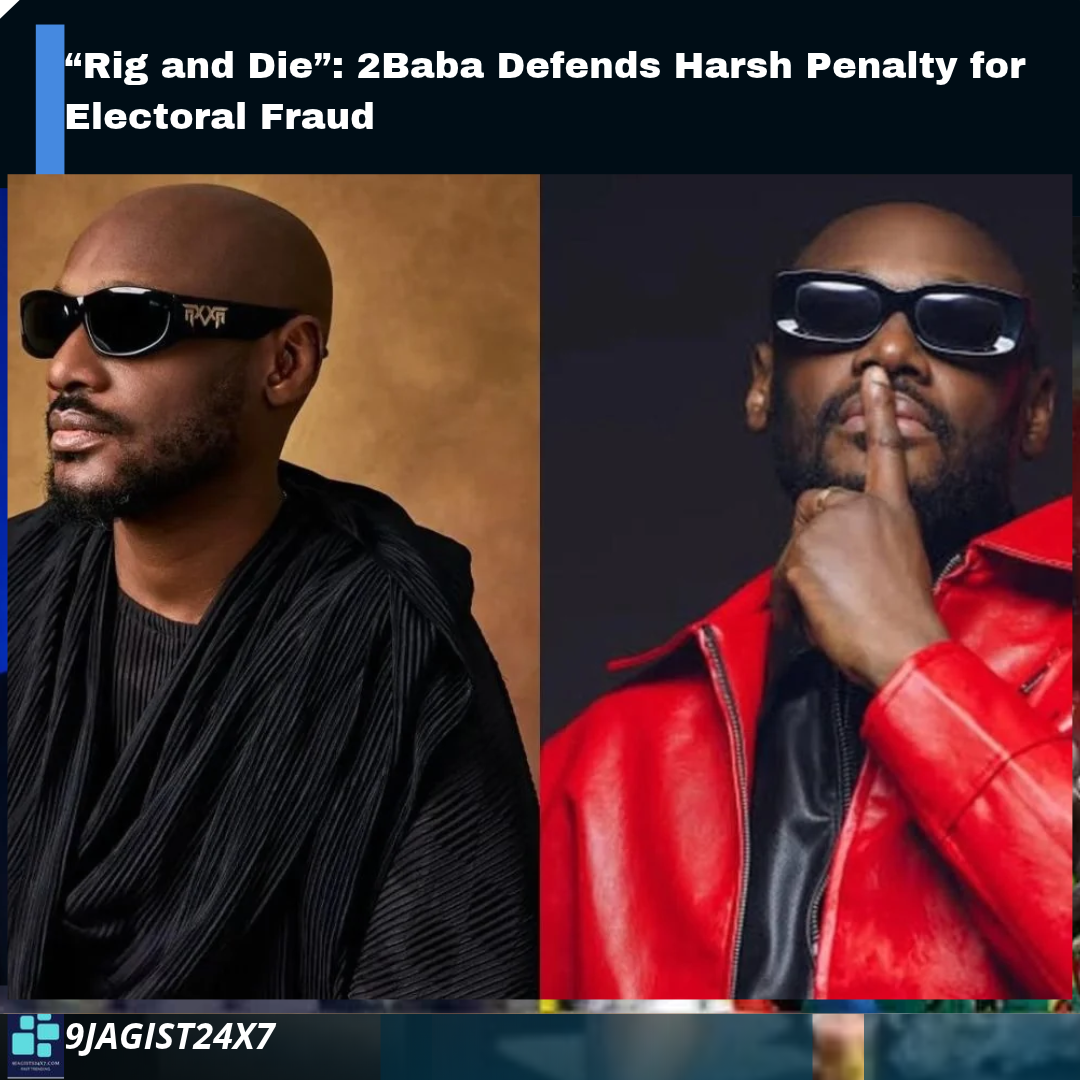
“I don’t see anything wrong with ‘rig and die’”: 2Baba backs severe punishment for election riggers
Nigerian music star 2Baba Idibia has weighed in on the controversy surrounding the “rig and die” statement, expressing support for severe punishment for people who manipulate election results.
Advertisements
Speaking during an appearance on Nigeria Info 99.3 FM, the singer argued that electoral offenders should face strict consequences to discourage others from engaging in the practice.
Advertisements
“If you rig, the punishment should be very, very severe to deter people from rigging. I don’t see anything wrong with the ‘rig and die’ statement,” he said.
Why 2Baba supports it
2Baba compared the statement to calls for severe punishment for people who embezzle public funds, citing China’s death penalty for certain corruption offences as an example.
“It’s like saying ‘embezzle money and die.’ Na death sentence for China for embezzlement,” he said.
His argument is simple: if electoral fraud carries no real consequence, politicians will keep rigging.
But that argument raises a harder question: who decides that someone has rigged, and what process protects innocent people from false accusations?The danger of the phrase
The Independent National Electoral Commission has cautioned politicians and their supporters against using the expression, warning that linking electoral offences to death could endanger voters and election officials.
INEC National Commissioner Mohammed Haruna said tensions at polling units could cause people to mistake delayed results, technical difficulties or rumours for evidence of rigging, potentially triggering violence.
That warning matters because election-day confusion is common. A slow result is not proof of rigging, and a rumour is not a verdict.
The legal problem
The All Progressives Congress has criticised the slogan, with its National Publicity Secretary, Felix Morka, questioning the legal basis for imposing the death penalty on alleged election riggers.
Morka’s point is not that rigging is harmless. It is that punishment must follow the law, not mob anger.
Nigeria’s electoral framework already provides for sanctions, including fines, imprisonment and disqualification for certain offences.
But enforcement remains the weak link. Many Nigerians believe the problem is not the absence of laws, but the failure to prosecute offenders.
What “rig and die” really means
The phrase is emotionally powerful because it speaks to a real grievance: stolen elections can undermine public trust and deny citizens their right to choose their leaders.
But it is also dangerous because it blurs the line between accountability and vengeance.
A person accused of rigging is not automatically guilty. Evidence, investigation, prosecution and a fair trial are what separate justice from mob rule.
The China comparison
2Baba’s reference to China is intended to make a point about deterrence, but it should not be treated as a precise legal comparison.
China does impose the death penalty for certain serious corruption offences, but not every act of embezzlement automatically attracts that punishment.
Using it as a shorthand for “rig and die” oversimplifies a complex legal system and risks encouraging a slogan that INEC has already flagged as dangerous.
What Nigeria needs instead
The stronger argument is not “rig and die” but “rig and face justice.”
That means:
-
Faster prosecution of electoral offenders.
-
Transparent investigation of allegations.
-
Protection for voters, polling agents and INEC officials.
-
Clear rules for handling disputed results.
-
Public communication that prevents rumours from turning into violence.
The bottom line
2Baba’s comment reflects the anger many Nigerians feel about electoral fraud.
But anger is not a legal standard. The country needs consequences that are severe, certain and lawful—not slogans that can put innocent people at risk.
Advertisements