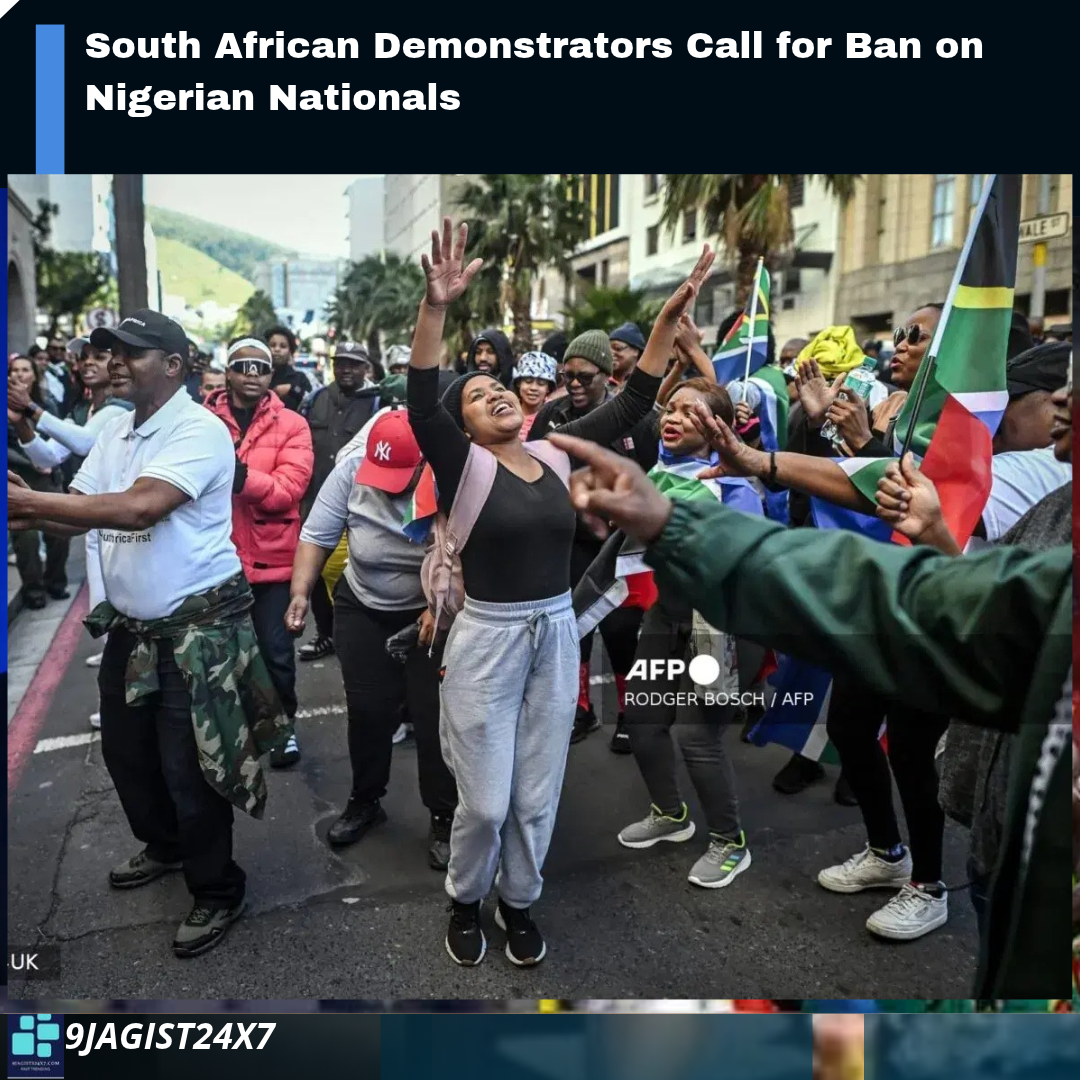
A fresh anti-Nigerian protest has erupted in South Africa, with demonstrators in Pretoria demanding that the government close its borders to Nigerian nationals and prohibit their entry into the country.
Advertisements
The demonstration was organised by the March and March movement on Wednesday and took place in Sunnyside, a Pretoria suburb with a sizeable Nigerian population popularly known as “Little Lagos.”
Advertisements
Protesters accused Nigerians of involvement in drug trafficking and worsening social problems in South African communities.
The group’s leader, Jacinta Ngobese-Zuma, led demonstrators through Sunnyside and questioned how the area acquired its Nigerian nickname.
“I am being told here that we’ve entered Sunnyside, the home of Nigerians. I am inviting Nigerians to come out, let’s talk to each other,” she said.
Ngobese-Zuma described the presence of migrants in South Africa as unsustainable, alleging that they were putting pressure on public resources and contributing to difficulties faced by South African citizens.
The group’s legal representative, Xolani Zuma, went further by calling for a blanket ban on Nigerians entering South Africa.
“The state must ban Nigerians from South Africa. They must ban Nigerians until they stop selling drugs to our people. The rest of Africa, we are fine, but we do not want Nigerians in South Africa anymore,” he said.
Ngobese-Zuma also urged the South African government to withdraw from the 1951 United Nations Convention Relating to the Status of Refugees.
She argued that the country’s obligations under the agreement were no longer sustainable or feasible.
The convention sets out protections for people fleeing persecution and establishes basic rights for refugees, including non-refoulement—the principle that refugees should not be returned to territories where they face serious threats to life or freedom.
The protesters’ claims target Nigerians as a group, rather than specific individuals alleged to have committed crimes. That distinction matters because criminal allegations must be investigated and proved against individuals, not used to justify collective exclusion.
South Africa has a history of xenophobic violence and anti-immigrant mobilisation. The protest follows earlier actions by groups such as Operation Dudula, which have pressed for undocumented foreign nationals to leave the country.
For Nigerians living in South Africa, the demonstration increases concerns about harassment, discrimination and safety, particularly in communities already identified as migrant-heavy.
The Nigerian government should monitor the situation and engage South African authorities to ensure that Nigerian citizens are protected from xenophobic violence, unlawful profiling and arbitrary restrictions.
It should also distinguish between legitimate immigration enforcement and blanket nationality-based bans. A blanket ban on Nigerians would be discriminatory and inconsistent with international human-rights and refugee-protection principles.
https://x.com/vanguardngrnews/status/2123397399574163587/analytics
South African authorities, meanwhile, should investigate specific criminal allegations through lawful processes while protecting all residents from hate speech and violence.
Advertisements