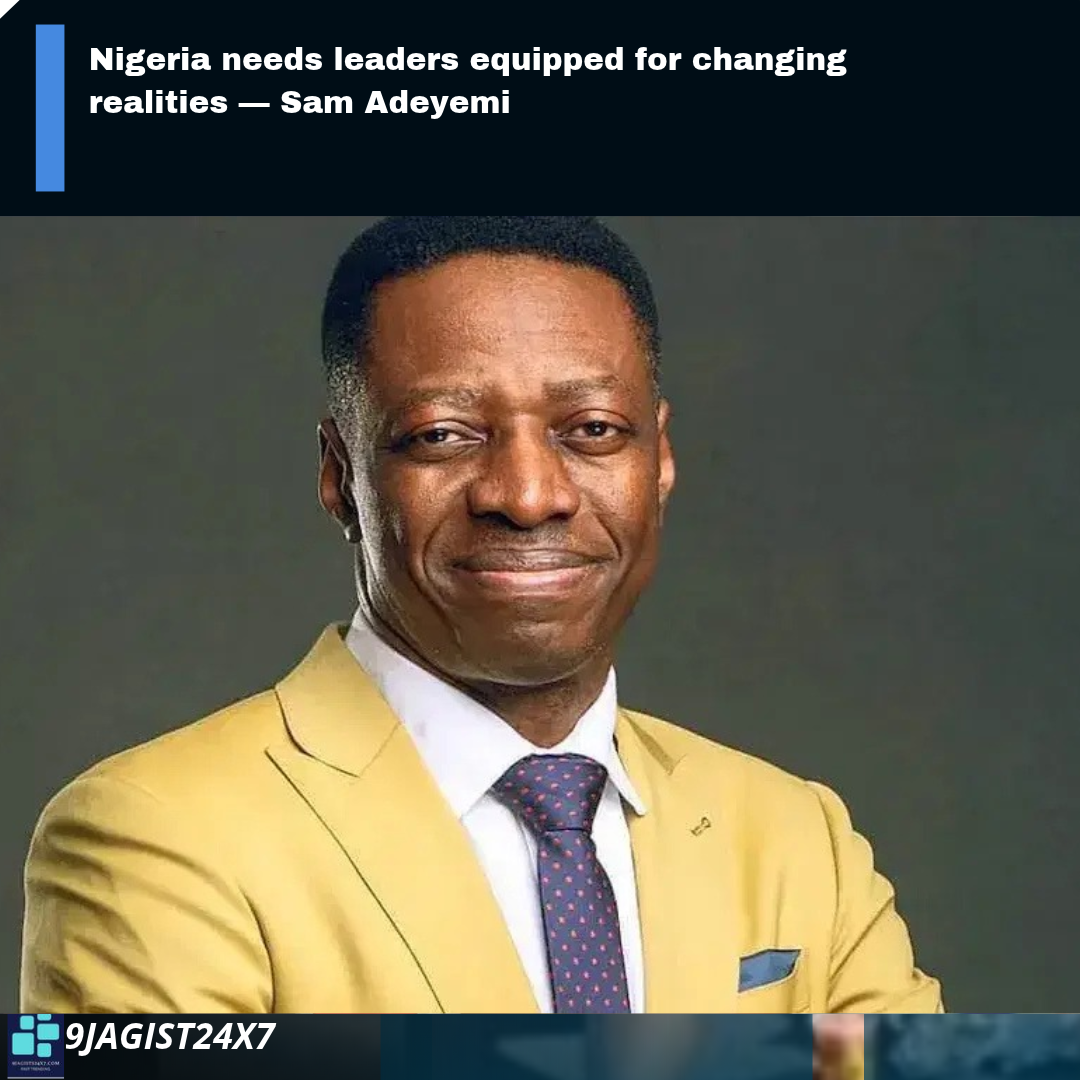
Pastor Sam Adeyemi, Senior Pastor of Daystar Christian Centre, has warned that Nigeria cannot afford leaders who learn on the job, arguing that many people in positions of authority have never received formal leadership training despite the country’s mounting economic and social challenges. He made the remarks in Lagos ahead of the 2026 edition of the church’s annual Excellence in Leadership Conference, scheduled for November 5 and 6 at Daystar Christian Centre, Oregun.
Advertisements
Adeyemi’s intervention comes at a time when Nigerians are grappling with volatile markets, rising living costs, policy changes, insecurity, and major transformations in the world of work. His message is that leadership should not be treated as an accidental by-product of political appointment, business success, or social status. Instead, he argues, it must be deliberately learned, practised, and refined before people are entrusted with responsibility over institutions, communities, and lives.
Advertisements
The pastor’s central concern is that Nigeria often places people in leadership roles without preparing them for the demands of those roles. He said that while it may be impossible to know in advance who will become a governor, senator, or holder of another major office, many of those who eventually occupy such positions have not learned leadership anywhere.
That observation goes beyond politics. Adeyemi’s argument applies to executives, public servants, religious leaders, community organisers, entrepreneurs, and managers. In his view, a country facing complex problems cannot rely on trial and error at the top. Leaders must understand how to make decisions under pressure, manage people, communicate clearly, build institutions, and respond to change.
His warning is particularly pointed because Nigeria’s challenges are not abstract. Citizens experience leadership through the quality of public services, the stability of the economy, the responsiveness of government, the security of communities, and the opportunities available to young people. When leadership fails, the effects are felt in hospitals, schools, roads, businesses, homes, and local communities.
The theme of the forthcoming conference, “Leading in Uncertainty,” captures the reality facing Nigerians today. Adeyemi and his wife, Nike Adeyemi, who co-host the event, said the programme will examine what it means to lead when the ground keeps shifting economically, socially, and personally.
The phrase reflects a world in which certainty has become scarce. Businesses face unpredictable markets and changing consumer behaviour. Workers confront automation, remote work, job insecurity, and new skills requirements. Families deal with rising costs and difficult financial decisions. Governments must respond to policy shocks, security threats, demographic pressures, and global economic changes.
Adeyemi’s message is that uncertainty should not paralyse leaders. Rather, they should learn how to stand firm, think clearly, and lead boldly while turning uncertainty into a leadership advantage. That framing suggests that uncertainty is not merely a problem to endure, but a condition that can reveal which leaders are prepared, adaptable, and capable.
Adeyemi’s argument rests on a simple premise: leadership is a skill, not simply a position. A person may hold an office without possessing the competence required to lead effectively. Conversely, someone without a formal title may demonstrate leadership through vision, discipline, empathy, strategic thinking, and the ability to mobilise others.
This distinction is important for Nigeria, where leadership is often associated with power, wealth, influence, or political access. Adeyemi is challenging that assumption by emphasising preparation. He is arguing that the country needs a pipeline of leaders who are trained before they assume responsibility, not after they have already made costly mistakes.
Leadership development can take many forms: formal education, mentorship, practical exposure, ethical formation, public-service training, and continuous learning. The key point is that leaders must be equipped to handle complexity. In a rapidly changing society, yesterday’s methods may not solve today’s problems.
The Excellence in Leadership Conference is presented as a practical response to the leadership gap Adeyemi identifies. Organisers say previous participants have described the event as a game-changer, with some attributing improvements in their careers and businesses to lessons learned at the conference.
That claim positions the event as more than a religious gathering. It is being marketed as a leadership-development platform for people who want to improve their capacity to navigate uncertainty, make better decisions, and lead in their respective fields. The conference is scheduled to bring participants together for two days of teaching, reflection, and practical engagement.
Adeyemi urged Nigerians to take advantage of the programme, describing participation as “a great investment” in their lives. His appeal is directed not only at established leaders but also at aspiring ones—people who may one day hold public office, run organisations, build businesses, or influence their communities.
Although Adeyemi did not endorse or criticise any particular politician, his comments carry clear political relevance. Nigeria is approaching another general election cycle, and questions about competence, preparation, and leadership capacity are likely to shape public debate.
The pastor’s remarks implicitly challenge voters to look beyond popularity, ethnicity, religion, money, and party loyalty. They raise a deeper question: does a candidate have the training, temperament, and experience to lead in uncertain times? Can they manage institutions? Can they build teams? Can they make difficult decisions while maintaining public trust?
At the same time, his message challenges political parties and institutions. If leadership is a learned discipline, then parties should invest in candidate development, governance training, and ethical preparation rather than relying solely on political connections or financial muscle.
Adeyemi’s call also speaks to a broader cultural issue: the tendency to treat leadership as something people are born into rather than something they must cultivate. In many societies, leadership is often linked to age, status, family name, religious title, or political patronage. Adeyemi’s argument pushes back against that mindset.
He is suggesting that Nigeria needs a culture in which leadership is intentional, accountable, and continuously improved. Such a culture would value learning, feedback, planning, and service. It would also expect leaders to admit gaps in knowledge and seek development rather than presenting themselves as infallible.
That shift would not happen through one conference alone. It would require sustained investment in education, mentorship, civic engagement, and institutional reform. But Adeyemi’s message contributes to a growing conversation about whether Nigeria’s leadership crisis is primarily a problem of bad individuals or a deeper failure to prepare people for leadership.
Nigeria’s changing realities demand leaders who can adapt without losing direction. Rising costs, policy uncertainty, technological disruption, and social pressure require more than slogans or personal charisma. They require leaders who can analyse problems, communicate honestly, build consensus, and act decisively.
Adeyemi’s warning is that the country cannot keep treating leadership as an afterthought. If Nigeria wants better outcomes, it must produce better-prepared leaders. The question is whether Nigerians, institutions, and political actors will take that challenge seriously before the next generation is asked to lead.
Advertisements